

From Unifying on Religion, Vision and Identity, Britain Now Unifies Upon Football

Before we debate immigration, unemployment, or the cost of living, there is a more fundamental question we are refusing to ask.
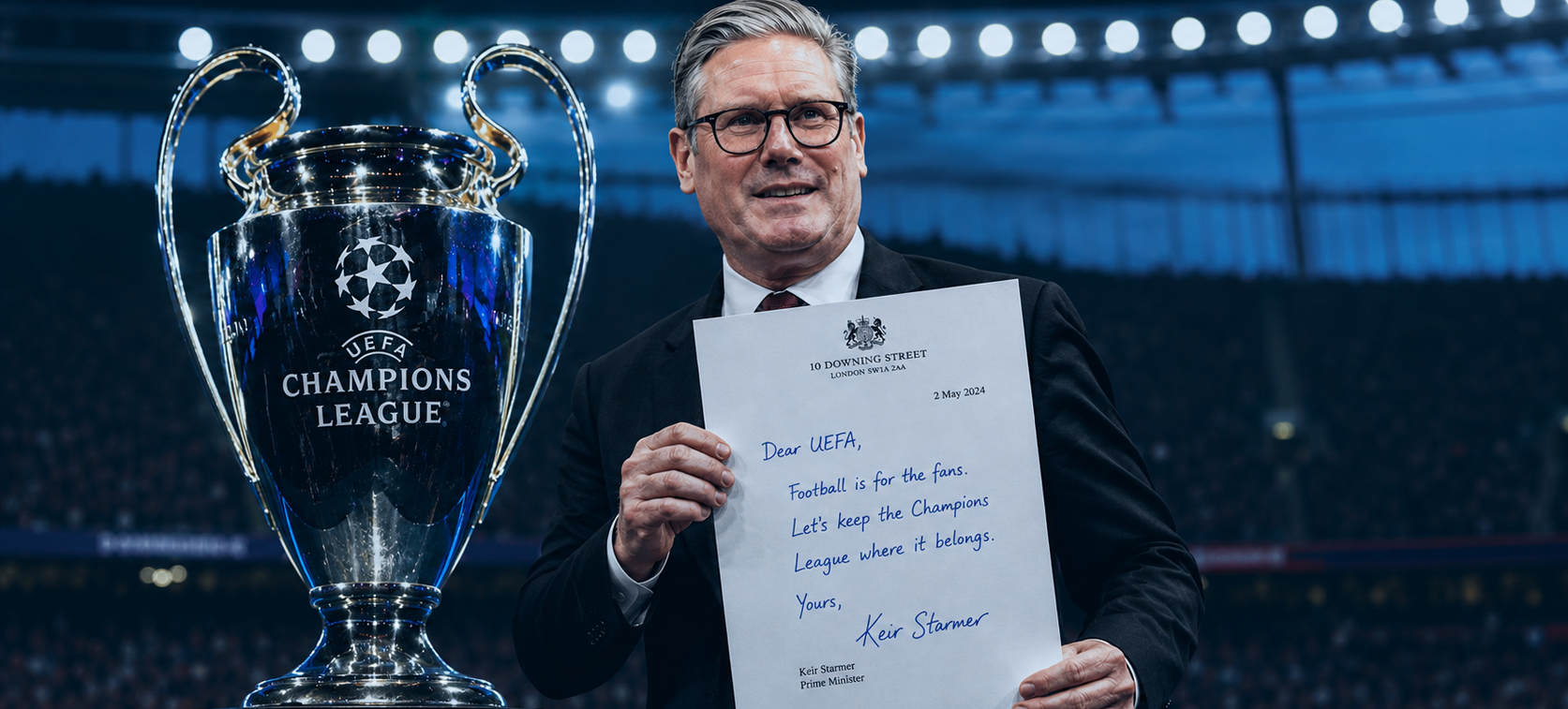
This week, Prime Minister Keir Starmer wrote a letter. Not about the economy, nor the NHS, nor immigration. These are issues his government is routinely hammered on. He wrote to TNT Sports, urging them to make the Champions League final free to watch. Starmer, a lifelong Arsenal supporter, was “saddened” that for the first time in the competition’s 34-year history, the final would sit behind a paywall. “Hard-working people,” he wrote, “should not have to worry about forking out for a subscription to watch a game of this magnitude.”
You can agree or disagree with his politics. But in that letter, Starmer said something quietly profound: that football is the thing that brings people together. That it belongs to everyone. That it is, in his own words, “bigger than that.”
And he is right. In a country that cannot agree on almost anything, football remains the last shared language. It is the one arena where a divided nation still gathers in living rooms, in pubs, in the streets and feels, however briefly, like one people.
That should give us pause, because if football is now the primary thing uniting Britain, it tells us something important about everything else that has been lost.
Britain is a nation in turmoil. Politically, it lurches from one extreme to the other never quite settling, never quite healing. Reform UK leads in national poll. Labour having suffered a humiliated defeat in the Local Council Elections. The Conservatives search for an identity of their own. The rise of Greens and Independents. The divisions feel raw, the arguments circular, the debate exhausting. But the political chaos is not the disease. It is a symptom. The real crisis runs much deeper, and it has been building quietly for decades.
Britain is suffering an identity crisis. Not a new one this began in the aftermath of the Second World War but the symptoms are now impossible to ignore.
What Britain Once Had
To understand what has been lost, you have to understand what Britain once had.
It had faith not merely in a theological sense, but as the architecture of everyday life. Churches sat at the centre of towns and villages, physically and spiritually. Christmas and Easter were not just holidays but communal rhythms that gave the year meaning. Marriage was a sacrament. There was a shared moral framework one that people lived within whether they were devout or not. Communities looked after one another. That is not sentimentality; it was the operating system of a functioning society.
The numbers tell their own story. In 2024, average Sunday attendance at Church of England services stood at 581,000 a third of the number that attended in 1968. Just 5% of all British adults now attend a Christian service weekly, compared with 8% in 2018. The churches did not empty because people found something better. They emptied because people stopped believing there was anything worth gathering for.
It had a shared vision. The British Empire whatever one makes of its moral record gave ordinary people a sense that they were living for something larger than themselves. There was a collective story being written, a sense of global purpose and significance that shaped how people carried themselves and how communities held together. You did not need to be a colonial administrator to feel part of something. The idea itself was enough.
It had the monarchy as an emotional anchor. Jubilees, royal weddings, births, and funerals were not mere spectacles they were moments of collective feeling. When Princess Diana died in 1997, the nation did not simply grieve a public figure. It grieved as one. Streets filled with flowers. Strangers wept together. That kind of shared emotional experience requires something to be shared in the first place a common identity, a common story.
It had industry, and identity rooted in honest, purposeful labour. Steel plants in Sheffield, coal mines in Sunderland, Vauxhall in Luton. These were not merely economic descriptors; they were sources of pride, of belonging, of inheritance. Multi-generational families worked in the same industries, the same communities. When people are bound together within a framework larger than themselves — a trade, a town, a shared calling relationships flourish. That is no longer the case for most of Britain.
And after the war itself, there was shared sacrifice. The collective effort to rebuild a battered nation created a solidarity that money cannot manufacture. People endured together, and that endurance meant something.
What Replaced It
Over time, each of these pillars was quietly dismantled and nothing was put in its place. What filled the vacuum was individualism. Not the healthy kind of individual freedom, but something far hollower: a civilisation re-organised entirely around the self.
What can I get? What does this say about me? How do I optimise my own experience?
The question of contribution to community, to nation, to something beyond oneself became unfashionable, then invisible. Before, people measured themselves by what they gave. Now they measure themselves by what they own: the car, the holiday, the postcode. We have shifted from a society built on contribution to one built on consumption.
Consumerism moved into the space that faith once occupied. According to a 2025 YouGov survey, 58% of British adults now believe religion has a negative influence on the world, with only 19% viewing it positively. Churches emptied. Shopping centres filled. The former bonded people around shared meaning. The latter bonds no one. It is a transaction, and transactions do not build societies.
Social media dissolved what remained of neighbourly life. A digital world without shared vision is not connection it is noise. And the consequences are measurable. According to the government’s own Community Life Survey, 7% of British adults now report feeling lonely often or always higher than at any point in the decade before the pandemic. Britain became the first country in the world to appoint a Minister for Loneliness, yet loneliness continues to soar to unprecedented highs. There are cases of people dying in their homes and their neighbours not finding out for weeks, sometimes months. That is not an immigration story. It is not a political one. It is a civilisational failure.
The family once the bedrock of social life has fractured under the weight of it all. The annual number of marriages in the UK peaked in 1972 at over 480,000. By 2019, that figure had fallen to around 250,000 halved, despite a population that has grown substantially.
Fifty or sixty years ago, the honour of women was considered sacred in mainstream British culture. Today, platforms monetising the degradation of women are celebrated as entrepreneurship. That shift did not happen because of any particular political party or demographic group. It happened because a society that loses its moral architecture loses everything that was built upon it.
The Question Nobody Is Asking
There is no shortage of debate in Britain. Immigration. Unemployment. Deindustrialisation. The cost of living. The NHS. These are real issues and they deserve serious attention.
But they are all downstream of something more fundamental a question that is raised and then quickly buried beneath the noise of the daily news cycle:
Who is Britain?
Fifty, sixty years ago, Britain knew the answer. It knew its story, its values, its place in the world. It had a shared sense of what it meant to be British imperfect and contested at the edges, perhaps, but real enough to hold a society together. There was a why a reason to get up in the morning that extended beyond the individual and their appetites.
Today, there is no shared answer. From the Black Lives Matter protests of 2020 to the anti-immigration riots of 2024, politics has become a contest of competing identities, each fighting for resources and recognition, with no common story large enough to contain them all.
This is the nature of a society that has lost its animating purpose. When a people no longer live for something greater than themselves — when the shared vision is replaced by individual appetite, and the bonds of community are replaced by the algorithm — the nation does not simply stagnate. It begins to come apart at the seams.
The political turbulence, the culture wars, the loneliness epidemic, the family breakdown, the rising tide of disillusionment these are not separate problems requiring separate solutions. They are different expressions of the same wound.
Before Britain can answer the questions about immigration, or industry, or opportunity before it can heal the divisions that increasingly define it it must first do something it has been avoiding for decades.
It must ask, honestly and without flinching: Who are we? And what are we living for?
Until that question is confronted, every other debate is just rearranging furniture in a house that has lost its foundations.


