

Why Did Vickrum Digwa Use The Race Card?

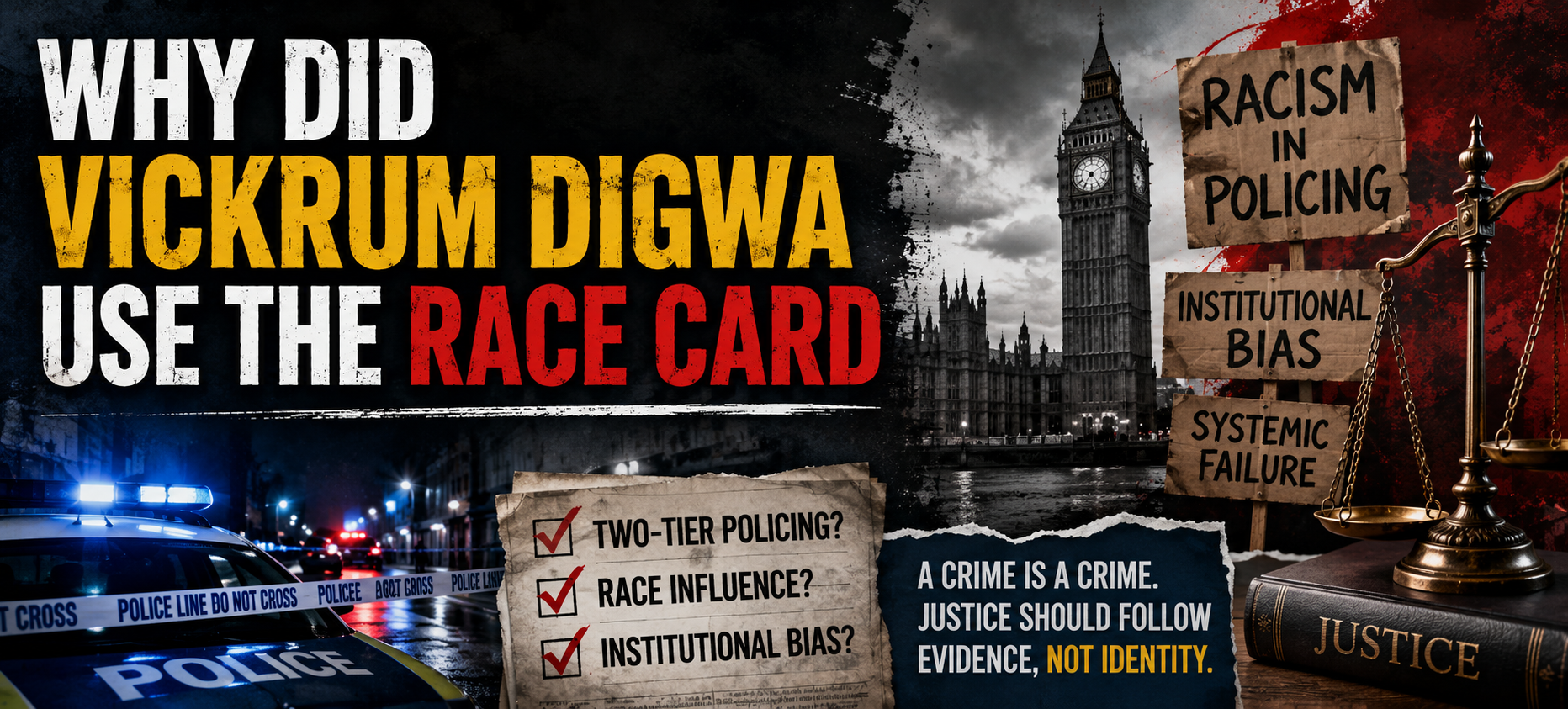
Henry Nowak lay dying from stab wounds while police officers attempted to understand what had happened. As the teenager’s life ebbed away, body cam footage showed officers treating him as a suspect, handcuffing him and reading him his rights while trying to piece together the events that had unfolded. The man later convicted of his murder, Vickrum Digwa, had presented a very different account of the incident, invoking allegations of racial abuse as part of his explanation for what had occurred.
Soon afterwards, the national debate settled into familiar trenches. Was this evidence of two-tier policing? Did race influence the response? Was this proof of institutional bias?
Within hours, Britain was once again arguing about race.
But in that rapid shift from tragedy to interpretation lies something deeper than this single case. Not the incident itself, but the reflex it triggered. Not the questions asked, but the framework those questions were forced into.
And it is here that the real issue becomes visible.
The real elephant in the room is not two-tier policing. It is not white against black. It is not immigrant against native.
It is Britain’s addiction to the race card.
The public anger surrounding this case centres on claims that race shaped how events were interpreted. But why should anyone be surprised?
For decades, Britain has taught its citizens that race is the first lens through which almost every social problem should be viewed. When the economy stagnates, race enters the discussion. When public services struggle, race enters the discussion. When social cohesion weakens, race enters the discussion. When politicians seek votes, race enters the discussion.
When the Brexit referendum unfolded, immigration, identity, and belonging often displaced deeper debates about economics, sovereignty, and governance. Time and again, race has become the preferred explanation for problems whose roots lie elsewhere.
The reason is simple.
Race is easier to talk about than failure. It is easier to blame communities than to explain decades of economic stagnation. It is easier to discuss identity than confront housing shortages, strained public services, stagnant wages, or institutional decline. It is easier to manufacture cultural conflict than to admit political responsibility.
Race becomes the perfect scapegoat.
And scapegoats are useful because they redirect attention away from those who hold power. This is why the obsession with race survives regardless of which party governs the country. The political culture itself has become dependent upon it.
In truth, this did not begin in the last decade. Its roots run far deeper.
The British Empire was built upon assumptions of racial hierarchy. Entire peoples were classified, categorised, and governed through ideas of civilisational superiority and inferiority. The notion that some nations were destined to rule while others were destined to be ruled provided moral cover for imperial expansion across vast parts of the globe.
Within that imperial order, ideas about race and hierarchy were not marginal—they were embedded in governance, education, and law. The habit of interpreting societies through group characteristics became part of the political language itself.
Even Churchill’s most celebrated vision of Britain was inseparable from the idea of a civilisation-spanning empire bound together under British leadership. While remembered primarily for his wartime defiance, the imperial world he sought to preserve rested upon assumptions of hierarchy between peoples and nations that shaped political thinking for generations.
That legacy did not simply disappear.
Many of the structures and assumptions of modern political life still reflect a tendency to understand society through identity categories—race, ethnicity, culture—rather than purely through shared civic or institutional realities.
The vocabulary has changed. The moral framing has changed. The targets have changed.
But the underlying habit of group-based interpretation remains.
That is why this case is so revealing.
Vikrum’s actions were his own, and his responsibility alone. Nothing can excuse violence. Nothing can excuse murder.
Yet the attempt to invoke race as part of the narrative is not an alien intrusion into public discourse. It reflects a political culture that has, for decades, encouraged society to interpret events through identity.
When facing scrutiny, blame race. When facing criticism, blame race. When facing failure, blame race.
For years, politicians, activists, media commentators, and institutions have all participated in variations of the same pattern. Why should anyone be surprised when individuals absorb and reproduce it?
The greatest danger now is that Britain learns the wrong lesson.
If every tragedy becomes another chapter in a racial argument, then the cycle simply continues. More division. More resentment. More suspicion. More communities viewing one another as competitors rather than neighbours.
Meanwhile, the deeper causes of social decline remain untouched.
A crime should first be seen as a crime. Violence should first be seen as violence. Murder should first be seen as murder.
Justice should follow evidence, not identity.
The Prophet ﷺ warned that previous nations were destroyed when one law existed for the powerful and another for the weak. His solution was neither privilege nor scapegoating. It was accountability.
“By Allah, if Fatimah, the daughter of Muhammad, were to steal, I would cut off her hand.”
In other words, justice must be blind to tribe, status, wealth, family, and race. The guilty answer for their actions. The innocent do not.
Yet modern political culture increasingly moves in the opposite direction.
Identity has become both shield and weapon. Entire communities are blamed for the actions of individuals, while individuals seek refuge behind the identity of their communities.
Once race becomes the primary framework through which events are interpreted, accountability begins to erode.
And that is why the race card remains so powerful.
It does not merely explain problems.
It deflects responsibility.
The riots, the anger, the mistrust, the accusations of racism, and the endless debates about policing are not the disease.
They are symptoms.
The disease is a political culture that has spent decades teaching people to look sideways at one another instead of upwards at those responsible for governing the country.
Today Britain is reaping what it has sown.
The seeds were planted long ago.
Seeds of division.
Seeds of identity politics.
Seeds of racial blame.
And now the fruits are visible for all to see.


