


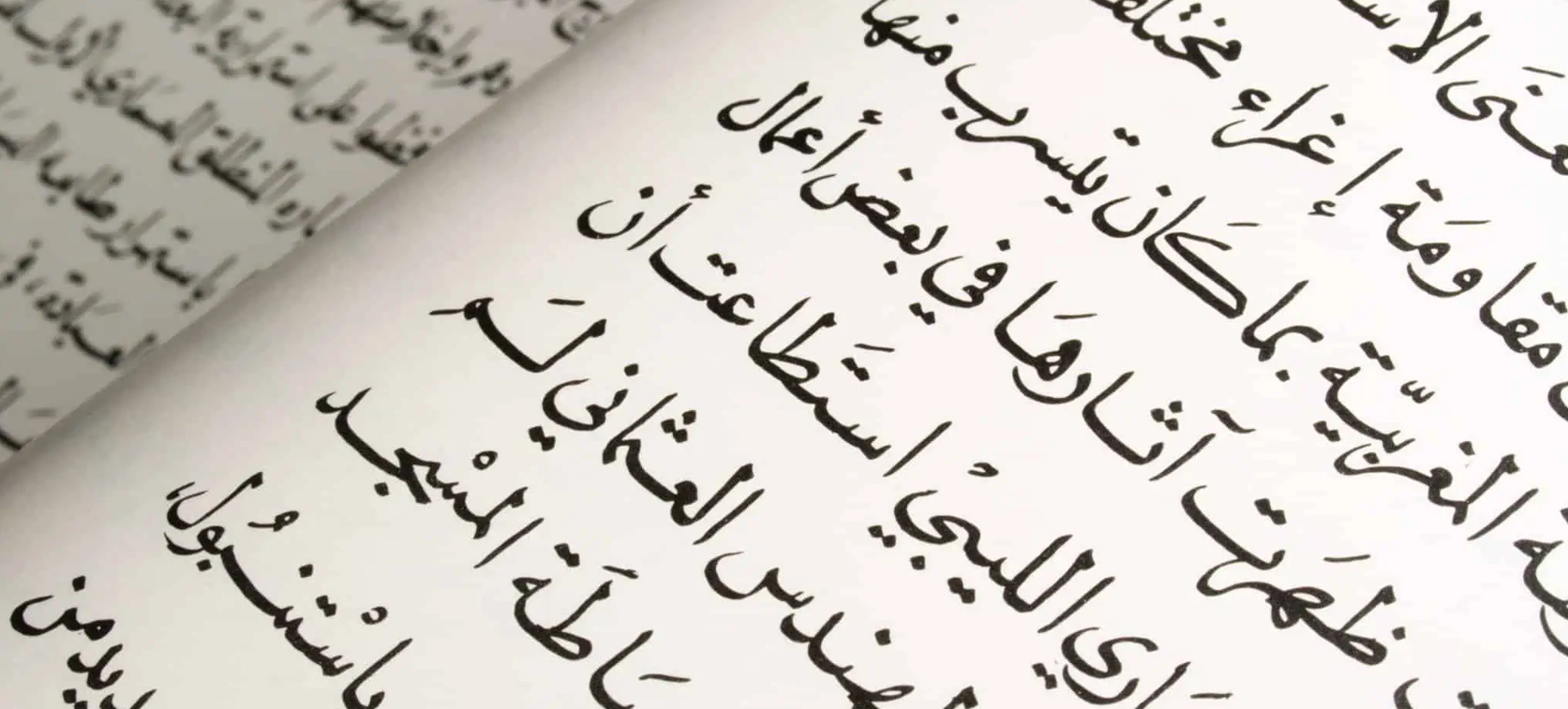
Islam began from a language of immense detail, through to growing and expanding with the same language. The question overlooked at times is ‘what is the correlation of the Arabic language with Islam?’.
Initially to clarify the contextual background of the sheer importance of such question, there is information that needs to be understood: Arabic was a language that universally symbolised Islam, it was the default mode of intergeographic communication and trade from end to end of Islam’s borders from around 76AH or 695CE. Within a century from this point, the Arabic language began to lose its status within Islam as well as subtly uncoupling the Muslim’s from the language’s core semantic precision. It was still predominant but this is when ulterior languages seeped through. The effect of this allowed trade and deeper political awareness of exterior regions and empires, however, the veiled core of Arabic began to be lost too. Under the Ottoman’s (the final reality of an Islamic civilisation), Islam began to drift further from its centralised mother tongue, it began to adopt languages at a larger scale which were from exterior regions to its province. Multifactors rooted to this, however it has an aligned conclusion which was a factor to the demise of the Islamic reign.
The lack of understanding of this profoundly deep language caused dependency to increase at a mass level. Due to the reality of the full extent of the language now being limited to few regions, many started becoming increasingly reliant on ‘Arabian scholars’ to declare ijtihaad (independent legal reasoning) rather than maintaining the dynamic intellectual capacity required to directly engage with, understand, and apply the primary sources as well as the demise of mass continuous analysis of the Quran and Sunnah and implementation of these. With reduction in Arabic, the ability to have a vast understanding in the deeper ideas portrayed through these mediums also declined, this reliance ultimately led to the beginning of Islam to not be seen through a clear, Quranic, unshaded lens… but now through a lens which is masked, filtered and obscured by ulterior ideas, due to the lack of internal understanding and increasing reliance on (as mentioned earlier), ‘Arabic scholars’. This process began to create misunderstanding of ayahs and hadiths, as they were extracted from contextual references, realities and implementations.
Islam began to become a breeding ground for knowledge without a purpose, without a mission… and that is powerful enough to destroy the minds of someone.
Islam has breadth and depth in levels that are now abstract to a Muslim, built up from a language alike in its detail, Arabic. The Arabic language is much more profound than the surface level of it.
To uncover the true power of Islam and its link with such a glorified language, we must first fully understand the following: the best way to collect knowledge about a subject is to go back to the original sources, in its original language. So when we speak about Islam, we should aim to treat
it similarly. Secondly, we need to decipher the reality of Islam, and the reality of its purpose through its primary format. Finally, the direct link between Arabic and Islam is paramount to unsheath, a religion that is completely immaculately planned and delivered, if it has been directed to be understood in a specific manner, we should follow that intended method to understand Islam.
The Arabic Language
An Example to Understand Before we Link the Language to Islam:
Majority of words in Arabic are created from multiple linguistic crafts, but there’s three in particular to be discussed: roots, patterns and derivatives. Majority of Arabic words are formed through a three lettered root, for example, the word ‘كتاب) ‘meaning book) has the root ب-ت-ك (meaning to gather, join or bind together). Now what can we extract from this. An Arabic word follows a pattern, to create a meaning from its root. If you look at the root, it means to gather, to join, to bind, now when we bind pages together we form a book. How can we further develop this understanding of the word, well we can look at words that come from the same root (i.e. a derivative), for example ‘كتبي ‘which means, bookseller or librarian, we can take from this derivative and build our understanding towards the word ‘كتاب ‘further. Now track back a few lines to when I mentioned ‘an Arabic word follows a pattern, to create a meaning from its root’. What does this actually mean? Words in Arabic are formed and structured through patterns, for example, look at these words and what you can see that is similar: ‘كتاب) ‘book), ‘حزام) ‘belt), ‘سوار‘ (bracelet). The similar sound you can hear from saying these words out loud is one of many patterns in the Arabic language, and we call this one, ‘فعال‘, which shares a similar sound. Now patterns have instructions, they tell you what to do to the root, to get your intended word, in this case we want the noun of ب-ت-ك. So this pattern ‘فعال ‘means a tool, physical object, or medium that embodies or performs an action. So now when we look at the word ‘كتاب‘, we have a much broader and deeper understanding than its face value of the word ‘book’, rather we understand that it is a physical object which binds together, a tool which joins and a medium which is the embodiment of gathering.
Islam and Arabic:
Once understanding the above, we can now really delve into the beautiful and intricate linking between the language itself and Islam. The Arabic word ‘إسالم) ‘Islam) is far more deeper than what we call a religion… let’s deconstruct the word and then build back up to the word. The root of the word ‘إسالم) ‘Islam) is ‘م-ل-س‘, which means to be intact, complete, uncorrupted, safe and free from flaws. The pattern the word follows is ‘إفعال‘, which signifies bringing a state into reality. So what can we develop form the root and the pattern. Islam is not a static idea, it is not diminished to the level of just a religion, but its an active process of surrendering to the All-Powerful, the All-Knowing, the All-Might… God. The pattern ‘إفعال ‘builds up the root ‘م-ل-س ‘to
understand that ‘إسالم) ‘Islam) is the reality of safety, it is the reality of something being free from flaws, being complete and its the reality of being forever intact. The question still stands though, how? How is ‘إسالم) ‘Islam) safe, free from flaws, complete, intact… well we have to now look at the third part, its derivatives. There’s three derivatives to cover so that we can understand ‘إسالم‘ (Islam) and the idea of being ‘مسلم) ‘Muslim) on a far deeper level. ‘سالم ‘meaning true peace and
safety, the idea of this being experienced when the soul and life is in complete order. ‘اسلم‘ meaning to yield, to surrender and hand oneself over completely without holding back. ‘سليم‘ meaning unbroken, uncorrupted and sound. Now what can we extract from these three derivatives (‘سليم ’,‘اسلم ’,‘سالم(‘, that come from the same root ‘م-ل-س‘. By understanding these derivatives, the idea of Islam can expand, Islam was never a passive title. Being ‘مسلم) ‘Muslim) is much deeper than saying you believe in a religion, it is an active surrender, (which get from ‘اسلم (‘that restores a human being to total internal and external wholeness (taken from ‘سليم (‘and gives ultimate peace, direction, conviction and dignity (gathered from ‘سالم(‘. This elaborates to us that ‘إسالم) ‘Islam) provides more than a symbol, it is a whole identity, it is a whole way of living, a completed worldview, that when operated in its intended form, produces ultimate soundness.
The Ultimate Link:
Just as the Arabic language has such depth, the way of life that is coupled with it (‘إسالم) ‘Islam)) follows that same trend, it has details and ideas that unpick all of the world’s issue, problems and thoughts. It provides a dynamic harmony like no other. ‘إسالم) ‘Islam) was never a religion for individuals, it is a collective effort to obtain that peace, that harmony, without the alignment of our identity to this worldview, without the collective submission to Allah, we leave large gaps in what we claim to believe in. ‘إسالم) ‘Islam) is not to be seen as basic rituals and a plain titles, its a comprehensive, complete, dynamic, harmonic system, incorporating every faculty of life to achieve a unified mission under a unified identity.