


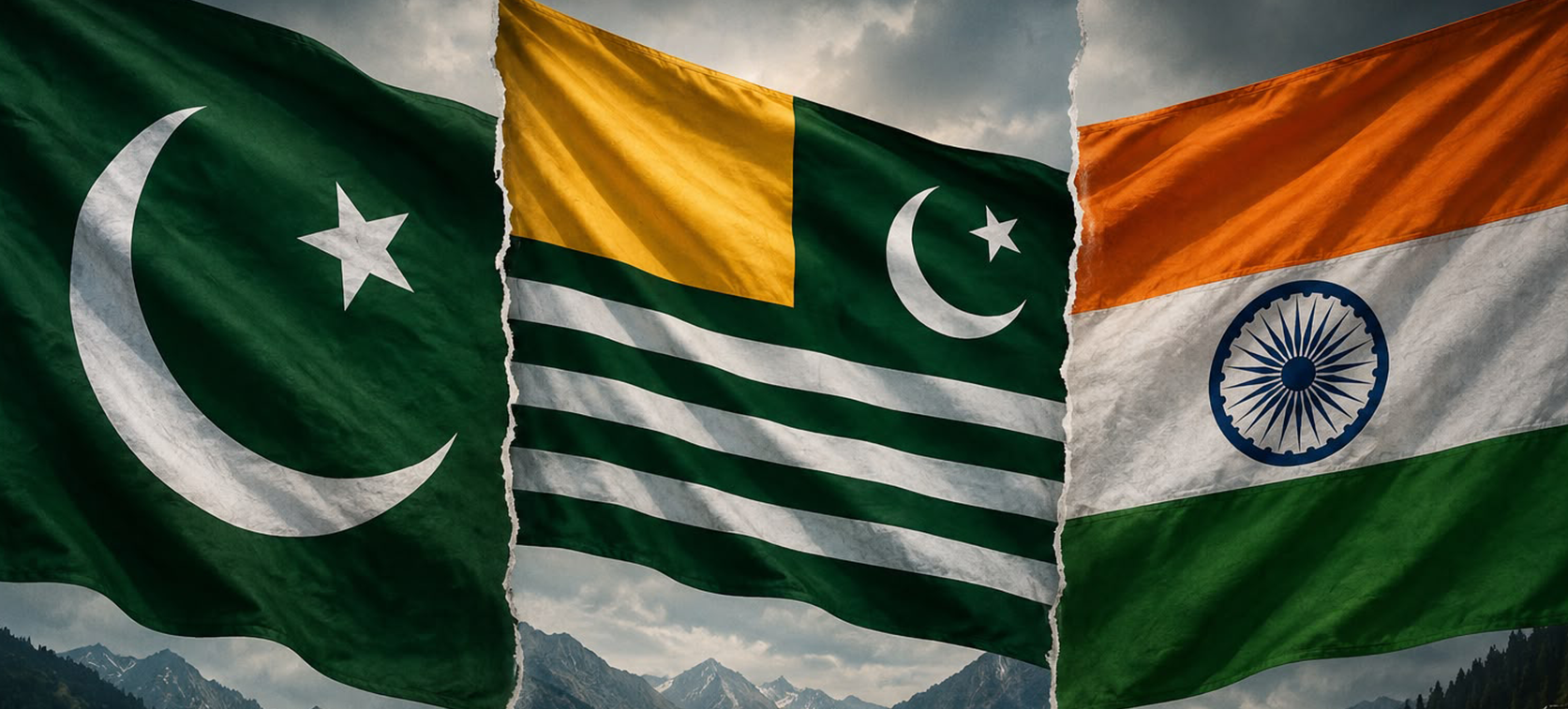
A Land Without a Home
The streets of Azad Jammu and Kashmir (AJK) have again been filled with gunfire, oppression and death. Over two days in late July, at least thirty people were killed in Mirpur and Rawalakot as security forces moved against protesters demanding a say in their own legislature. Islamabad’s response was not restraint but reinforcement: federal ministers publicly backed the crackdown, and those in the streets were redefined overnight from protesters into rioters. A civil society movement, the Joint Awami Action Committee (JAAC), had months earlier been proscribed as a terrorist organisation for demanding that twelve reserved assembly seats created for refugees of the 1947 war finally be reassigned to the people who actually live under this government today.
None of this is new. It is the third consecutive year that Azad Kashmir has drifted into deadly unrest, each time over the same unresolved grievance: a territory built to look self-governing, with its own prime minister, its own assembly, its own courts, while the real decisions are made elsewhere. To understand why, it helps to go back to where this shape was first drawn.
How the Land Was Divided
Kashmir’s modern wound opens in 1947. As British India was partitioned, the princely state of Jammu and Kashmir, Muslim-majority, ruled by a Hindu maharaja was left to choose a side. War broke out before the choice was settled, and by the time a ceasefire line was drawn in 1949, the state had been split in two: one part occupied by India, the other by Pakistan. Two further wars, in 1965 and 1999 (along with many more border skirmishes), hardened that line without ever resolving the underlying question of to whom the land, and its people, truly belonged.
The Pakistani side was given the name Azad Jammu and Kashmir also known as “Free” Kashmir and a constitution that reads, on paper, like genuine self-rule. In practice, from the outset, Islamabad retained the authority that mattered: defence, foreign affairs, currency and the ability to override the regional government whenever it became inconvenient. The people of AJK were handed the furniture of a state without the foundations of one.
Power Concentrated, Wherever It Sits
What is happening today is simply that arrangement being tested and failing. A grassroots movement asks for a change to electoral seats that everyone privately concedes is outdated even the AJK government’s own accounting admitted that most of a forty-four-point reform list had been implemented, while the one demand that touches the actual balance of political power was left untouched. When the people affected pushed harder, the state did not negotiate. It cut the internet, arrested organisers en masse, labelled the movement a terrorist threat, and then opened fire.
This is not an accident of one bad government. It is the pattern of how power behaves in Pakistan more broadly, where authority has long been tightly controlled by the all-powerful military supported by bureaucratic and political elites who treat regions like Kashmir, and populations like the Kashmiris, as assets to be managed rather than citizens to be served. The crackdown in Rawalakot is not a departure from how governance operated in Pakistan. It is a faithful demonstration of it.
Why “Independence” Is Not the Answer Either
It would be convenient, at this point, to conclude that the solution is simply to remove Pakistan and India from the equation altogether and let Kashmir stand on its own. But this is where the geography of the region tells a harder truth than the politics does. An independent Kashmir would be a landlocked territory boxed in by three of Asia’s largest powers India, Pakistan, and China with no coastline, no independent trade route, and no path to the outside world that does not run through the territory of a much larger neighbour. Sovereignty of that kind is not sovereignty; it is a client relationship wearing a flag. Whoever governed an “independent” Kashmir would still need Islamabad’s roads, or Delhi’s ports, or Beijing’s goodwill, to do almost anything at all. The dependency does not disappear because the border does.
So the honest accounting is this: Kashmir under India has meant statehood revoked and free speech throttled. Kashmir under Pakistan has meant, this summer, live fire on its own citizens over a demand for basic representation. An “independent” Kashmir would be landlocked and encircled by India, Pakistan, and China, it would still depend on larger powers for trade, security, and access to the outside world. The patron might change, but the captivity would remain. Three different flags, the same structural dependence.
The Root the Nationalism Obscures
What all three options share is the thing nationalism is designed to hide: that the argument over which flag flies changes little about who holds power and how they are
permitted to use it. Kashmiris are not short of options for who might rule them. They are short of a model in which whoever rules them is actually bound by something higher than their own convenience.
That is the deeper claim this piece is making, and it applies well beyond Kashmir’s hills to Pakistan as a whole and to much of the Muslim world besides. The dignity that Kashmiris, Pakistanis, and Muslims elsewhere are searching for in nationalism, in secession, in the next election, is not something a border can supply. It was supplied once in a specific and recorded model of governance: rule that was accountable rather than absolute, that treated consultation shura as an obligation rather than a courtesy and that held rulers to the same standard of justice as the ruled. The Qur’an describes believers as those “who conduct their affairs by mutual consultation” (42:38) not as a pious sentiment, but as a description of how legitimate authority is supposed to function. A ruler who cuts off the internet rather than answer his people has not simply made a tactical error; he has abandoned the standard by which his rule was ever meant to be judged.
Until governance across Pakistan, and across the Muslim world, is answerable to that standard rather than to the preservation of whichever elite currently holds the reins, it will not matter whose map Kashmir sits on. The crackdown will simply move to wherever the next demand for accountability is raised. The dignity Kashmiris are dying for this summer will not be restored by a new border. It will only be restored by a different relationship between power and the people it is meant to serve.