


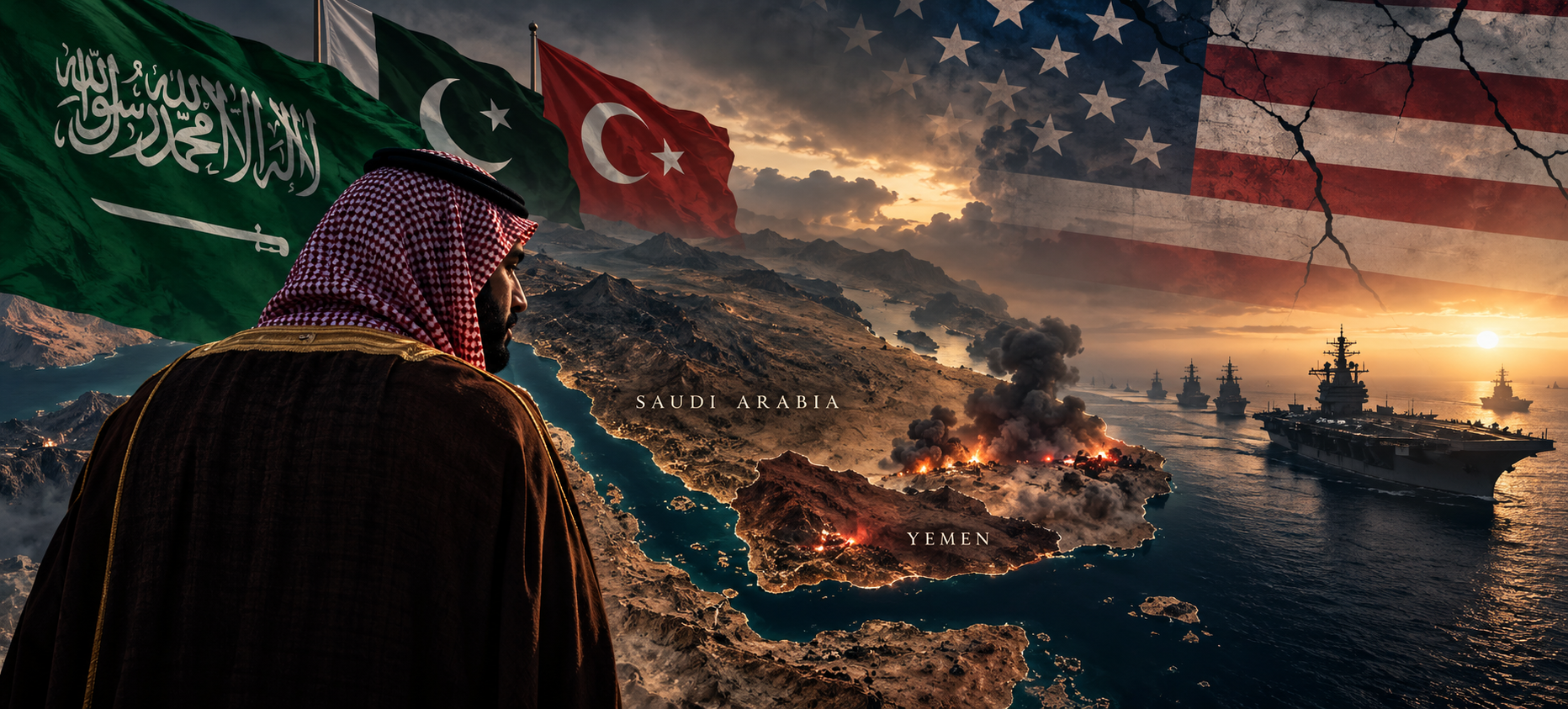
The decline of American dominance may not begin with military defeat, but with the moment its allies stop believing in the security guarantees upon which its global influence was built.
Saudi Arabia is facing a serious security challenge on its southern border.
The renewed confrontation with Yemen’s Houthi movement has brought missile and drone threats, military operations and growing concerns over the security of the Red Sea and its vital shipping routes.
Riyadh has looked towards Washington, its longstanding security partner, for military support against the Houthis.
Yet the United States has been reluctant to become directly involved in another prolonged military campaign in Yemen.
The reasons are understandable. American military resources face competing demands, another war could prove costly, and direct intervention risks widening an already volatile regional confrontation.
But behind these calculations lies a question far more consequential than whether America launches another military operation.
What happens to a world order built upon American security guarantees when those guarantees become subject to American convenience?
The Promise That Made America Powerful
For decades, American dominance in the Middle East has rested upon more than military superiority.
It has rested upon a bargain.
Countries aligned themselves with Washington, purchased American weapons, accommodated American strategic interests and, in return, expected American protection.
Saudi Arabia became one of the clearest examples of this arrangement.
Its relationship with Washington helped establish American influence over regional defence planning, intelligence cooperation, arms procurement and wider geopolitical decisions.
It was an effective system because American military power did not always need to be exercised. The belief that America would intervene was often enough.
But a security guarantee derives its value from credibility.
The US–Saudi relationship is not an unconditional mutual-defence treaty, and declining to participate in an offensive does not necessarily constitute a broken legal commitment.
Nevertheless, the political question remains.
If a country has organised its security around American protection, what happens when Washington decides that providing it carries too high a price?
The ally begins to reconsider the relationship. And that reconsideration may prove more damaging to American influence than any military setback.
When Security Was a Covenant, Not a Convenience
History offers an instructive contrast.
More than fourteen centuries ago, the emerging Islamic state confronted the same fundamental question: what does a government owe those to whom it has promised protection?
The early Islamic political tradition developed the concepts of amān, a guarantee of safety, and dhimmah, a binding undertaking of protection.
These carried religious and legal responsibilities.
The Treaty of Hudaybiyyah in 628 CE permitted tribes to ally themselves with either the Muslims of Madinah or the Quraysh of Makkah.
Banu Khuza’ah allied themselves with the Muslims, while Banu Bakr joined the Quraysh.
When Banu Bakr attacked Khuza’ah with Quraysh support, the victims appealed to Prophet Muhammad ﷺ.
The attack was treated as a breach of the wider treaty arrangement. Following demands for redress, the confrontation culminated in the conquest of Makkah.
An attack upon an allied community was understood to create an obligation, even when fulfilling it risked confrontation with a powerful adversary.
An equally revealing example comes from the Caliphate of Umar ibn al-Khattab.
During the early Muslim campaigns in Syria, agreements were established with local populations involving taxation and protection.
When a major Byzantine mobilisation threatened Muslim positions, historical accounts preserved by al-Baladhuri report that Abu Ubaydah ibn al-Jarrah ordered the return of revenues collected from communities that Muslim forces could no longer defend.
Although the precise details cannot be independently verified in their entirety, the principle preserved in the historical tradition is striking.
The Muslim authorities did not simply retain the benefits of an agreement while declaring its obligations too costly.
If a state can no longer provide the protection upon which an arrangement was established, what right does it have to continue enjoying its advantages?
The Caliphate was not without political failures or broken agreements. But its governing legal ideal was clear.
The Qur’an states:
“And fulfil the covenant. Surely the covenant will be questioned about.”
— Qur’an 17:34
This did not mean that a state was obliged to fight every war regardless of circumstances. Rather, it established that promises carried responsibilities beyond immediate political convenience.
The comparison with modern American security arrangements is not legally exact. But the underlying question of accountability remains relevant.
A Security Alliance Capable of Replacing American Power
Saudi Arabia’s growing defence cooperation with Pakistan and Turkey should not be viewed merely as an attempt to diversify its security arrangements.
Its potential significance is far greater.
Such cooperation could provide the foundations of a regional security order capable of challenging America’s military and political dominance in the Middle East.
Consider what these countries collectively possess.
Pakistan brings nuclear deterrence, a substantial standing army and decades of military experience. Turkey possesses one of NATO’s largest armed forces, an increasingly sophisticated defence industry and considerable operational experience. Saudi Arabia contributes enormous financial resources, strategic geography and influence across the Arab and Muslim world.
Individually, these countries remain constrained by their relationships with Washington. Turkey is a NATO member, Pakistan has longstanding military and financial dependencies, and Saudi Arabia’s defence infrastructure remains deeply integrated with American systems.
But these dependencies should not obscure their collective potential.
The real question is not whether these countries currently possess the independence to challenge American dominance. It is whether they possess the capabilities to establish that independence if the political will existed.
A serious security alliance, supported by integrated military planning, independent defence production, intelligence cooperation and a common strategic objective, could develop into a formidable regional force.
Not simply a coalition capable of confronting the Houthis, but one capable of fundamentally altering the balance of power in the Middle East.
Defeating an armed movement in Yemen is a limited military objective. Establishing an independent regional security architecture is a geopolitical transformation.
Such an alliance would face formidable obstacles, including competing national interests, American military integration and the economic consequences of challenging Washington. Displacing the US military presence would also require broader regional political agreement.
But these are questions of political will and strategic commitment, not simply military resources.
The irony is that the very countries upon which Washington has relied to sustain its regional influence possess, collectively, many of the resources needed to build an alternative to it.
For decades, American dominance has depended not only upon military superiority, but upon the fragmentation and strategic dependence of regional powers.
A credible alliance committed to collective security and genuine political independence would challenge both.
The question is no longer simply whether America will defend its allies. It is whether those allies might eventually establish a regional order that no longer requires American protection.
Military Superiority Is Not Political Authority
None of this means that America has ceased to be a formidable military power.
Its technological capabilities, intelligence networks, naval strength and global military infrastructure remain extraordinary.
But military strength and geopolitical authority are not interchangeable.
Washington faces a difficult dilemma.
If it intervenes in every confrontation involving its partners, it risks exhausting its resources and becoming trapped in costly wars.
If it refuses, its partners may increasingly pursue independent security arrangements.
Neither choice automatically signifies decline. But the dilemma exposes the growing costs of sustaining an international order in which one country has positioned itself as the ultimate guarantor of so many others.
Other governments watching Washington’s response will inevitably examine their own security relationships.
Some enjoy formal collective-defence treaties. Others depend upon political understandings and expectations of support.
Those distinctions matter legally, but the political question remains.
If our security depends upon Washington, how certain can we be that Washington will act when our interests and American calculations no longer coincide?
The World Order May Change Before America Realises It
There is a tendency to imagine the decline of great powers as a dramatic event.
A military defeat. An economic collapse. The emergence of a rival superpower.
But an international order can begin to change while its military bases remain operational, its institutions remain intact and its leaders continue speaking the language of supremacy.
The transformation takes place in the decisions of other states.
An ally signs an independent defence agreement.
A government diversifies its weapons suppliers.
A regional power begins negotiating without first seeking Washington’s approval.
Individually, these decisions may appear insignificant.
Collectively, they represent a redistribution of geopolitical authority.
The historical lesson is not that powerful states can guarantee protection under every conceivable circumstance.
It is that a security guarantee must mean something beyond the convenience of the moment.
A state that enjoys the political advantages of being another country’s protector must recognise that those advantages carry responsibilities.
Otherwise, the relationship gradually ceases to be one of assured protection and becomes one of calculated dependency.
And dependency, once recognised, invites alternatives.
The United States may continue possessing the most formidable military capabilities in the world. It may continue operating bases, selling weapons and maintaining alliances across continents.
But if its partners increasingly conclude that their security requires arrangements independent of Washington, then something fundamental will have changed.
American power will remain.
American indispensability will not.
And perhaps that is how a world order begins to end: not when its dominant power loses the ability to command, but when others lose the need to obey.
Need Help?
-
 [email protected]
-
 Follow us on Instagram
-
 Follow us on TikTok