


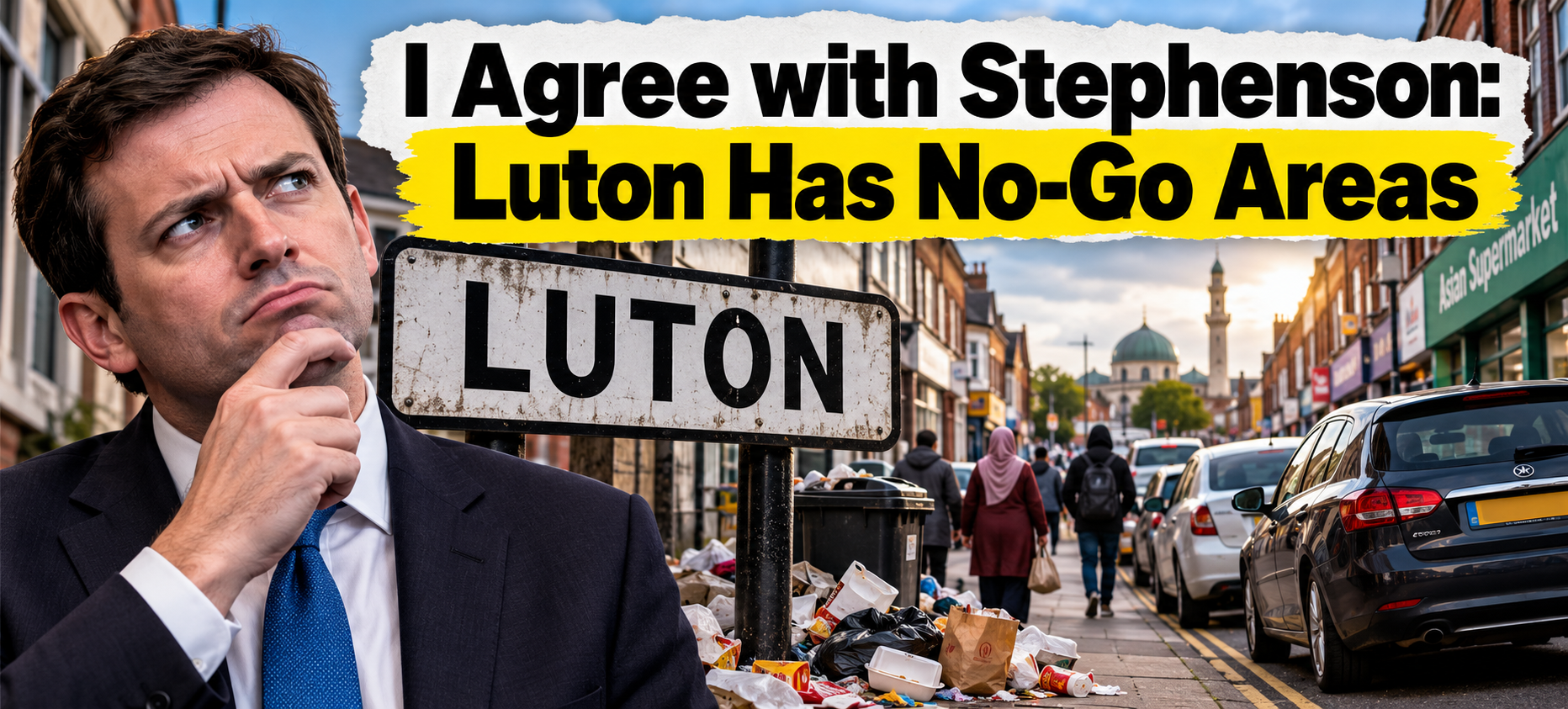
There are parts of Luton I wouldn’t dare set foot in. Not because I’m afraid of being racially excluded, but because I’d quite like to make it home alive without being flattened by a car parked halfway across the pavement, navigating a mountain of discarded takeaway boxes or having to negotiate with motorists who appear to regard pedestrians as an unfortunate design flaw in the highway system.
So when Conservative MP Blake Stephenson announced that parts of Luton were effectively no-go areas for white people, I thought, finally, a politician has noticed the state of our streets.
Alas, I had given him too much credit.
It wasn’t the pavements, the litter or the apparent suspension of the Highway Code that troubled him.
It was the ethnic composition of the people living there.
Apparently, the real danger lurking in certain parts of Luton isn’t a speeding car or a blocked pavement. It’s the possibility of encountering too many brown people in one afternoon.
Bedfordshire’s Chief Constable, inconveniently, has rejected the existence of these supposed no-go areas. But why allow something as mundane as police evidence to interfere with a perfectly good political headline?
And that is where the comedy ends.
Because when a politician begins confusing the presence of ethnic minorities with the exclusion of white people, we are no longer discussing the condition of a town.
We are discussing the condition of British politics.
Britain Has a Short Memory When It Comes to Race
There is a peculiar irony in hearing a British politician speak as though racial exclusion were something introduced to Britain by its immigrant communities.
The British Empire did not invent racial prejudice. But it certainly helped institutionalise racial hierarchy on an extraordinary scale.
Across its colonies, race was used to organise power, privilege and access to opportunity. Colonial administrations classified populations, distributed authority unequally and frequently governed through divisions between communities.
The message was unmistakable: some people were born to rule, while others were expected to obey.
And the psychological consequences of that history did not simply disappear when the Union Jack was lowered.
Even today, among some elders in Britain’s South Asian communities, there remains a particular deference towards a white person in a position of authority.
Anyone familiar with that generation will recognise the scene. An elderly gentleman, perfectly confident among his own community, suddenly becomes nervous when confronted by a white official. His English falters, his posture changes, and he appears almost to shake in his shalwar kameez.
Where does that come from?
It certainly did not emerge from a history in which South Asians exercised racial dominance over the British.
It reflects, at least in part, a colonial inheritance in which whiteness became associated with authority, status and power, reinforced for some by experiences of discrimination after migration.
That is not to suggest that minority communities are incapable of prejudice. They are, like every other community. But there is a profound difference between individual prejudice and the historical machinery of racial hierarchy.
And it is remarkable how easily that history disappears when politicians wish to portray white Britons as the victims of exclusion.
The Convenient Disappearance of White Flight
There is another chapter of British history that rarely features in these conversations.
White flight.
Across parts of Britain, particularly during the decades following Commonwealth immigration, some established white residents moved away as neighbourhoods became increasingly diverse.
Not every departure was racially motivated. Economic mobility, changing housing markets and suburban development all influenced where people lived.
But racial attitudes also played a role.
Meanwhile, many immigrant families faced housing discrimination, restricted opportunities and hostility. They settled where accommodation was available, where relatives and friends had established themselves, and where communities could provide mutual support.
Over generations, they built businesses, bought homes, established institutions and raised British-born children.
Now their presence is being presented as though it constitutes a barrier to white people entering those same neighbourhoods.
Think about the absurdity of that argument.
When some white residents chose to leave increasingly diverse neighbourhoods, that was treated as a matter of personal choice. When minority communities became established there, their presence could suddenly be described as racial exclusion.
A neighbourhood does not become a no-go area simply because the majority of its residents are no longer white.
Nor does the presence of mosques, Asian supermarkets or people speaking different languages constitute evidence of hostility.
If Stephenson has evidence of actual racial intimidation, he should present it.
Otherwise, he is confusing demographic change with discrimination.
When Political Vision Gives Way to Racial Grievance
Which brings us back to Blake Stephenson.
What is his vision for Bedfordshire?
What serious proposals does he have for improving its infrastructure, strengthening public services, addressing deprivation or restoring confidence in neglected town centres?
Those are questions worth putting to him.
Instead, his remarks have placed race at the centre of the conversation.
It is difficult not to see the political opportunity in that choice.
Britain’s political climate has become increasingly receptive to arguments built around cultural anxiety, immigration and identity. Such arguments attract headlines, provoke reactions and generate the kind of attention that detailed proposals about housing, transport or local government rarely receive.
Whether Stephenson intended to exploit that climate is a question only he can answer.
But the effect of his remarks is clear: rather than inviting people to consider how Bedfordshire might improve, they invite people to consider which ethnic communities supposedly make parts of it unwelcoming.
Race becomes the conversation. Policy becomes an afterthought.
And therein lies the danger.
A politician does not need to explicitly encourage racial hostility to contribute to a divisive atmosphere. Sometimes all that is required is to suggest that one community’s presence is another community’s loss.
It is a familiar political technique: identify an anxiety, give it an ethnic explanation and allow the resulting controversy to dominate public attention.
Whether it wins votes is a matter for the electorate. But it certainly risks leaving the underlying problems untouched.
Luton Needs Solutions, Not Scapegoats
Luton is far from perfect.
Its streets need attention. Its infrastructure needs investment. Its residents deserve better public services, cleaner neighbourhoods, safer roads and a local environment in which people can take pride.
These are problems that cross ethnic and religious boundaries.
A white pensioner struggling along a pavement obstructed by parked cars has something in common with an elderly Pakistani woman navigating the same street.
Neither is helped by a politician turning their neighbourhood into a racial talking point.
There is nothing wrong with discussing integration. There is nothing wrong with addressing genuine racial hostility wherever it exists. And there is certainly nothing wrong with acknowledging that demographic change can create social tensions.
But these conversations require evidence, historical understanding and a willingness to address problems rather than exploit them.
Britain has spent centuries dealing with the consequences of racial hierarchy, colonialism, migration and social division. It deserves a more mature political conversation than one that treats the visibility of ethnic minorities as evidence of white exclusion.
Perhaps Stephenson should spend less time searching for streets white people supposedly cannot enter and more time asking why so many of Bedfordshire’s residents, whatever their background, feel that their communities have been neglected.
Because the real no-go area in British politics increasingly appears to be the territory of serious ideas.
And judging by these remarks, some politicians seem determined never to venture into it.
A Final Word to the People of Luton
And finally, to the residents of Luton: you really don’t need to start rolling out your best friend Mohammed or Steve to prove that you get along with people of different backgrounds.
You don’t need photographs of multicultural dinner parties, declarations of lifelong friendships or heartwarming stories of neighbours sharing cups of tea.
Your friendships are not exhibits in a courtroom, and your everyday lives do not require political validation.
There is something almost absurd about ordinary people feeling compelled to demonstrate their decency every time a politician makes a sweeping claim about their community.
The question is not whether Luton can produce enough examples of racial harmony to satisfy Blake Stephenson. The question is whether such remarks deserve to set the terms of the conversation in the first place.
Must an entire town defend its character every time a politician questions it? Perhaps the more revealing question is why we allow politics of this kind to command so much of our attention.
Need Help?
-
 [email protected]
-
 Follow us on Instagram
-
 Follow us on TikTok