


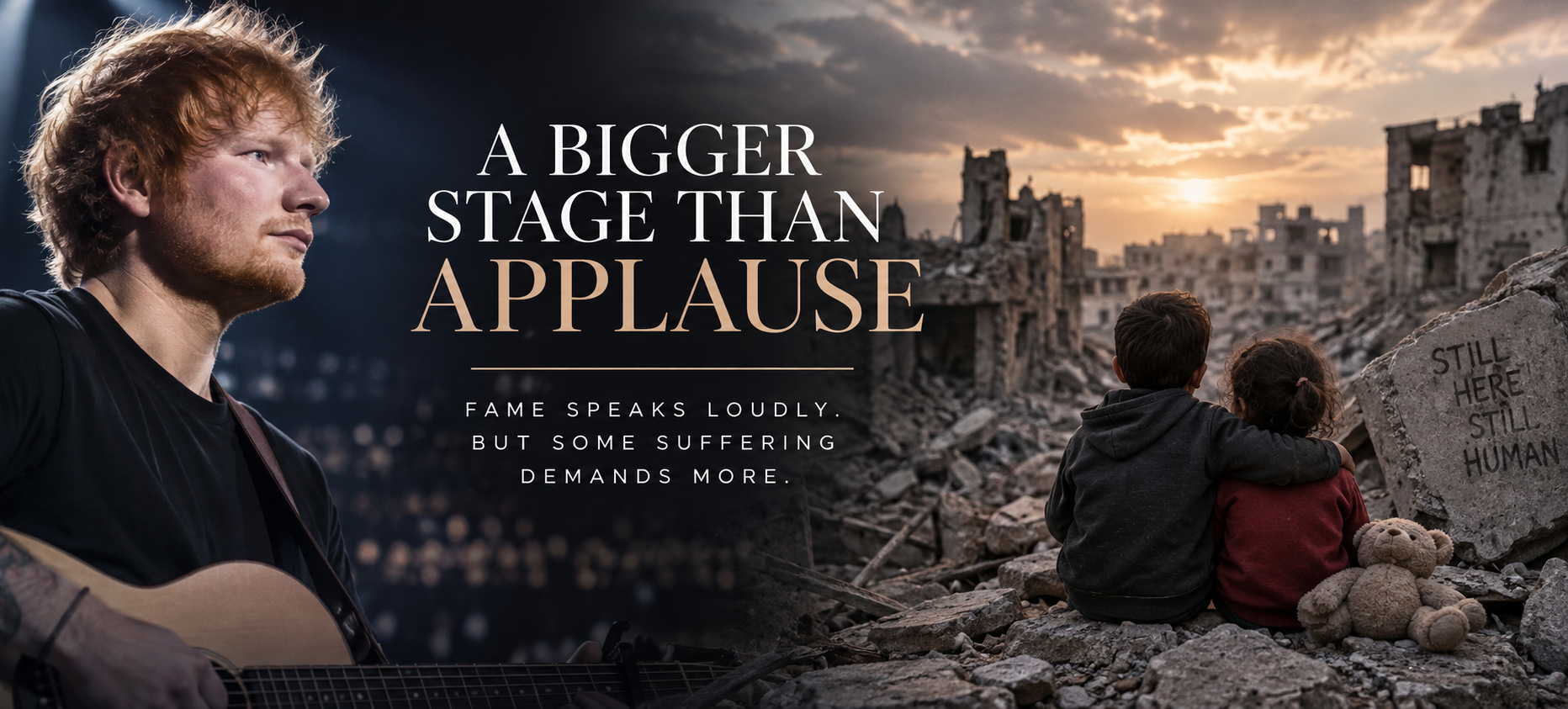
Dear Ed,
I read your recent statement, and one sentence stayed with me:
“Just because I choose not to speak publicly, it doesn’t mean I don’t have [views], and it doesn’t mean I don’t care.”
I believe you when you say you care.
But I fundamentally reject the idea that, in circumstances such as these, private concern is an adequate answer to public silence.
You have said that you choose not to use your professional platform for politics. Yet when Ukraine was invaded, you did exactly that. You performed at the Concert for Ukraine and helped raise millions for people affected by that war.
But that leaves an uncomfortable question which deserves an answer:
Why was Ukraine a humanitarian issue worthy of your voice, while Palestine has apparently become politics requiring your silence?
You cannot comfortably occupy both positions without explaining the distinction.
When Ukrainian civilians suffered, using your fame to help them did not prevent your concerts from being places of what you now call “safety and sanctuary.”
So why would acknowledging Palestinian suffering suddenly threaten that sanctuary?
Speaking up cannot depend upon geography. Empathy cannot change according to the identity of the people underneath the rubble.
And principle cannot mean speaking when speaking is safe, then retreating into silence when speaking becomes expensive.
Your own family has Irish roots. Ireland carries within its history the memory of famine, displacement, and a suffering population desperately needing the outside world not to look away.
During the Great Famine, Ottoman Sultan Abdul Hameed contributed to Irish famine relief.
He wasn’t Irish.
Those starving were not his people.
Their suffering wasn’t his responsibility.
His belief was enough.
There is something profoundly relevant in that history today.
Sometimes oppression requires us to reach beyond nationality and status and recognise suffering simply because another human being is enduring it.
And perhaps, Ed, before defending silence as diplomacy, it is worth looking more closely at the people about whom you have chosen not to speak publicly.
Look beyond Gaza as a political argument and look at the ground facts.
Look at what has enabled so many to endure extraordinary loss without surrendering their dignity.
For many of the people of Palestine, that strength is inseparable from their faith.
Islam teaches that principle is not something you possess only while it remains convenient. Faith is tested precisely when holding on to what you believe becomes costly.
Sabr is often translated simply as patience, but it carries something much deeper: steadfastness, perseverance and remaining anchored when circumstances give you every reason to abandon what you stand for.
Perhaps there is something in that worth examining.
Journalists have continued reporting despite extraordinary danger.
Doctors and nurses have continued treating the wounded amid devastation.
Parents have buried children and somehow found the strength to continue caring for those who remain.
Families have been displaced and stripped of almost everything familiar to them.
And through unimaginable grief, the words Alhamdulillah — praise belongs to God — have continued to leave people’s lips.
That deserves more than our sympathy.
It should make us examine what principle actually means.
Because their faith contains an uncomfortable lesson for anyone watching from safety:
Expediency does not trump principle.
Profit does not trump principle.
Comfort does not trump principle.
Fear does not make principle negotiable.
You speak about maintaining diplomacy.
Others have had to worry about maintaining their humanity while everything around them was being taken away.
The potential consequences you face for speaking are real. Criticism is real. Commercial pressure can be real. Venues, contracts and professional relationships matter.
But compare those consequences with those faced by the people whose suffering prompted this entire controversy.
Their choice was not between principle and a concert.
It was not between conscience and a contract.
It was not between speaking and protecting wealth.
For some, the consequences surrounding the work they continued to do have included injury, displacement and death.
And still they continued.
Surely that should inspire something in you.
Ed, you could fill every stadium on your tour, in every country across the world, and have every person inside them rise to their feet and applaud the stance of those in Gaza in the face of what they regard as genocide — and still, that applause would fall short of acknowledging what we have witnessed.
Because what deserves recognition is not simply their endurance.
It is what their endurance is made of.
Belief.
Principle.
Conviction.
Substance.These are people who have shown the world that principle is not something to display when the lights are on and the consequences are comfortable.
Principle reveals itself when there is something to lose.
And they have had almost everything to lose.
That is why Gaza should not merely evoke sympathy from those watching from safety. It should cause you to examine the substance of your own convictions.
If their principles can survive hunger, bereavement, displacement and the possibility of death, surely yours should be able to survive the possibility of losing applause, a contract or a concert.
Which brings me back to perhaps the most important words in your statement:
“I am not complicit.”
I don’t believe any of us gets to absolve ourselves quite so easily.
Complicity does not always require enthusiastic participation.
History teaches us something far more uncomfortable: terrible things can also continue because enough people see what is happening, privately disagree with it, perhaps even privately grieve over it, but ultimately conclude that speaking carries too great a personal cost.
The sum of silence is complicity.
Not because every silent person supports what is happening.
But because silence removes another voice that might otherwise have challenged it.
And when that silence belongs to someone whose voice reaches tens of millions of people, it is not insignificant.
You have every right to remain silent.
But please don’t mistake silence for neutrality.
Silence is a choice.
And choices have consequences.
Nobody needs Ed Sheeran to explain the Middle East to them.
Nobody is asking you to become a politician.
Nobody requires you to possess the perfect words.
The question is much simpler:
Does the suffering of the people of Palestine move you publicly in the same way Ukrainian suffering did?
Because if the answer is yes, then why does one suffering deserve your voice while the other receives your silence?
You describe your platform as a place of “safety and sanctuary.”
Perhaps look towards the people for whom safety and sanctuary have become desperately scarce.
Look into the faith that has sustained so many of them.
Within that belief you may discover something directly relevant to the dilemma you have described:
Principles that survive only while they are profitable are not principles. They are preferences.
You stood publicly for Ukrainians when they were suffering.
I am not asking you to care less about Ukraine.
I am asking you to apply the same humanity without qualification.
Why should the people of Palestine deserve anything less?
Your fame does not place you above that question.
If anything, the size of your platform makes the question harder to avoid.
M Khan (Editor R3Run)
Need Help?
-
 [email protected]
-
 Follow us on Instagram
-
 Follow us on TikTok