


Beyond the Checklist
Most of us, at some point, have measured our lives against a checklist. Whether that is completing our education, to securing that first job, finding a life partner and to achieve financial freedom. As a muslim that checklist is expanded to include completing our salah, fasting during Ramadan, doing good deeds and avoiding major sin. These are all noble acts and this article in no shape or form is downplaying them, it in fact encourages them to the highest degree. However if we continue living our lives against a checklist, well checklist by their very nature have a bottom – a point where you say ‘done.’ The life of a Muslim has no such bottom, it has a horizon. These rituals of Islam are the foundation, the mistake is treating them like a ceiling.
Building on Foundation
Allah says in Surah Al-Baqarah, in verse 30, “Indeed, I will place a khalifah upon the earth.” This Ayah, reinforces the idea that Human beings have been created with purpose and responsibility, not just to worship in seclusion but to build and maintain something. Furthermore, one could argue through this Ayah, Allah has commanded us to work towards something that may outlast our time on this earth. Islam gives every human being a purpose before it gives them a rulebook. And that purpose, as the Quran describes it, is not simply to observe, it is to steward. To be entrusted with something precious and to take responsibility for its care, its growth, and what it becomes. This is a subtly but profoundly different way of seeing your life. You are not here merely to get through it. You are here to contribute to something that matters.
Mindset of a Visionary Muslim
A visionary mindset is not something reserved for leaders, scholars, or historical figures. It is available to anyone willing to reorient the way they see their daily life. The shift begins with a single question: am I consuming this life, or am I contributing to something through it? The two can look remarkably similar from the outside — same job, same home, same routine — but they are oriented in entirely different directions. One is organised around the self. The other is organised around a purpose that extends beyond it.
In practice, this mindset reshapes everything it touches. It changes how you raise your children — not simply to succeed in the world’s terms, but to carry something of worth into the next generation. It changes how you invest your time — understanding that every skill, every relationship, every resource you have been given is a trust, not a possession. It changes how you respond to difficulty — because a person with a long horizon is not easily broken by short-term setbacks. It means that the most ordinary moments carry real weight. The parent who raises a child with a sense of mission. The professional who brings integrity into spaces where it is rare. The person who invests in their community not for recognition, but because they understand they are part of something larger than themselves.
The Quran captures this orientation with quiet precision: ‘Let every soul look to what it has put forward for tomorrow.’ Not what it has accumulated. Not what it has achieved. What it has put forward — planted, built, contributed — for what comes after. And the Prophet ﷺ modelled it in the most vivid terms: “If the Hour is established and one of you has a seedling (or a small palm shoot) in his hand, and he is able to plant it before the Hour overtakes him, let him plant it” Narrated by Anas ibn Malik (ra), recorded in Musnad AhmadThe act of purposeful contribution is itself the point, regardless of whether you live to see what grows.
Nur ad-Din Zangi: A Man Who Lived the Vision
History remembers Salahuddin al-Ayyubi as the man who liberated Jerusalem. But history is less generous to the man who made Salahuddin possible, that man is Nur adDin Zangi, ruler of Syria in the 12th century was not a figure who lived in the glow of great victory. He lived in one of the most painful periods of the Ummah’s history. Jerusalem was under Crusader occupation, the Muslim world was fragmented, fractious, and in many places, more concerned with internal rivalries than with the collective wound of Al-Aqsa being under occupation. Nur ad-Din, was born into a reality not too dissimilar to ours today, yet he remained focus and firm on his vision, which was to nurture a generation of Muslims who eventually did liberate Jerusalem. Today, where we see genocide unfolding in Gaza and leaders more concerned with national interest than the collective wound of the Ummah, it is easy to feel paralysed, as though the scale of what is wrong makes the question of what to do pointless. The life of Nur ad-Din answers that feeling directly. He never waited for the world to be ready. He built it anyway.
What made Nur ad-Din remarkable was not simply his military capability, even though he was a formidable military commander. It was his character. He was known for his modest lifestyle. He rejected the trappings of power and was deeply committed to justice in his governance. He built schools, hospitals and institutions across Syria at a time when the temptation for any ruler would have been to consolidate power and enjoy it. He understood, in a way that very few of his contemporaries did, that the liberation of Jerusalem was not first a military problem. It was a spiritual and civilisational one, you could not reclaim a holy city with a broken people, you have to build the people first.
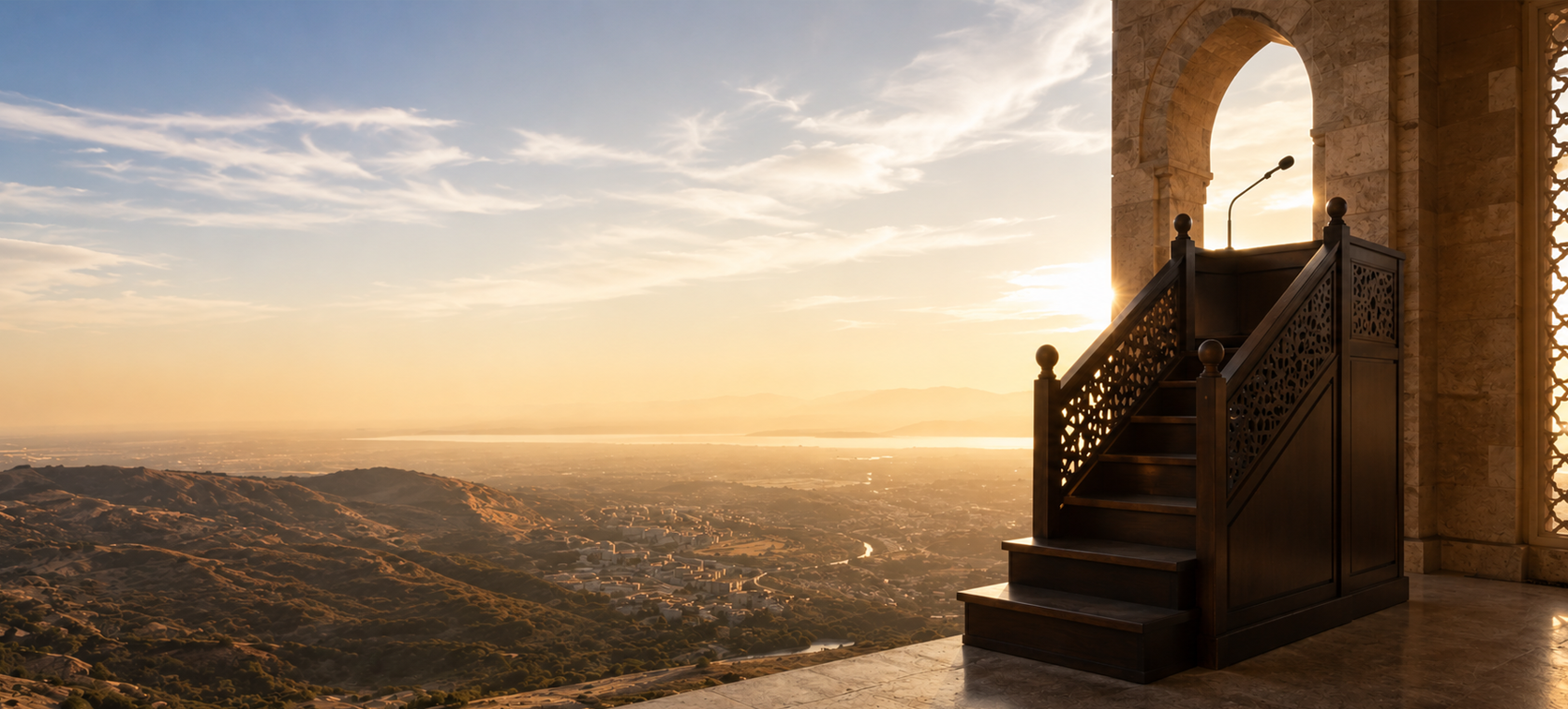
But perhaps the single most powerful expression of his vision is something that rarely makes it into history books. Nur ad-Din commissioned the construction of a handcrafted wooden minbar intended to be placed inside Masjid Al-Aqsa upon its liberation. He never saw that day. He died in 1174, thirteen years before Salahuddin rode into Jerusalem. But when Salahuddin liberated the city in 1187, he placed that very minbar inside Al-Aqsa, exactly as its maker had intended. A man built a pulpit for a mosque that was not yet free, in a city he would never reclaim, for a moment he would never witness.
Today the Ummah yearns for another Salahuddin to rise and liberate the holy lands. We look to the horizon for a hero a singular figure who will arrive and set things right. But perhaps this is precisely the wrong question. Salahuddin did not appear from nowhere. He was built. Shaped by years of deliberate investment from a man who understood that liberation begins long before the battle in the classroom, in the character, in the quiet and unglamorous work of preparation. The world does not need to wait for the next Salahuddin. What it needs, urgently and in abundance, is the next generation of Nur adDins men and women who are willing to build without guarantee of reward, to invest in people without knowing what those people will become, to commission the minbar even when Jerusalem is not yet free. Salahuddin was the moment the world saw. Nur ad-Din was everything that made that moment possible.
The Question That Remains
Nur ad-Din never gave a speech about legacy. He never wrote a manifesto about vision. He simply woke up every day in a broken world and chose to build something within it quietly, seriously, and without waiting for permission or perfect conditions.
That is the invitation this article leaves you with. Not a checklist. Not a set of instructions. Just a question one worth sitting with honestly: what are you building?
Not your career. Not your savings. Not your reputation. But what are you actually contributing to that will matter when you are gone? What are you planting that you may never sit under? Who are you shaping, investing in, or serving – not for recognition, but because you understand that you are part of something that stretches far beyond your own lifetime?
The Quran reminds us that Allah records not just what we have done, but what we have left behind. Every institution, every person we shaped, every seed of goodness we planted it outlasts us. That is not a burden. It is perhaps the most liberating truth in all of Islam. Your life is not just yours. It is a contribution to something eternal.
Nur ad-Din did not live to see Jerusalem free. But he died having done everything within his power and his position to move the world toward that moment. That minbar built in Aleppo for a mosque not yet free, in a city not yet reclaimed was his answer to despair. It was his refusal to be paralysed by what he could not control, and his insistence on doing what he could.
In a world that tells you to focus on yourself, your comfort and your immediate returns choosing to live with a longer horizon is itself an act of resistance. And it begins not with a grand gesture, but with a question asked sincerely, in private, perhaps for the first time:
What is my Minbar?
Need Help?
-
 [email protected]
-
 Follow us on Instagram
-
 Follow us on TikTok