

Seven Prime Ministers: Different Faces, Same Issues

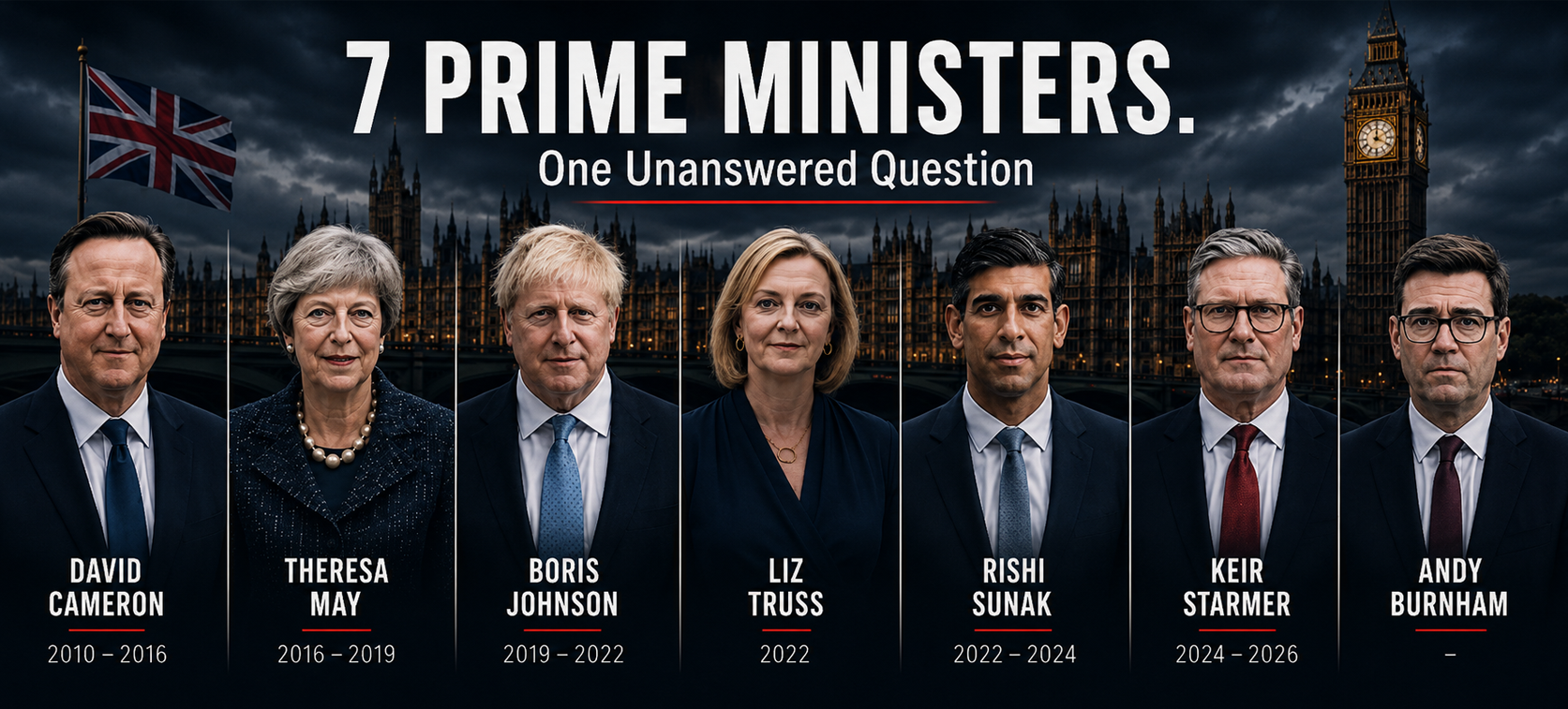
Britain keeps changing its leaders. It has never once changed the question it refuses to ask.
In the space of ten years, Britain is about to see its seventh Prime Minister appointed. That means that, in the past decade, this country has seen six Prime Ministers come and go. Beginning with David Cameron, who left in the fallout from Brexit; Theresa May, who broke herself trying to deliver a Brexit nobody could define; Boris Johnson, whose government collapsed under the weight of scandal, most famously Partygate; Liz Truss, who lasted just forty-five days after her chaotic budget; and Rishi Sunak, who was swept out in a landslide. Keir Starmer was elected after fourteen years of Conservative rule, carried into Downing Street on the expectation of something steadier, cleaner, and new. But the promise of renewal quickly gave way to weakness: U-turns, drift, and a deep rupture with parts of Labour’s Muslim base over his comments and stance on Gaza. Now Starmer becomes the sixth Prime Minister to fall through the revolving door, and in his place it is widely anticipated that Andy Burnham, the former Mayor of Greater Manchester, will become the seventh — if he is elected unopposed by Labour.
Six Prime Ministers have come and gone. And not one of them could answer the question that mattered most.
Not — how do we fix the NHS? Not — how do we grow the economy? Those are real questions, but they are not THE question. The question — the one that sits beneath every political failure of the last generation — is this: What is Britain, and what is it governing for?
Until that question is answered, the revolving door will keep spinning. The faces will change. The crises will not.
Six Leaders. One Pattern.
It would be convenient to blame the individuals. And there is plenty to blame. Johnson’s moral recklessness. Truss’s economic illiteracy. May’s political paralysis. But that framing lets the system off the hook.
Look past the personalities and a pattern emerges. Each of these leaders arrived with promises. Each governed in a state of perpetual crisis management. Each departed having failed to articulate let alone deliver a coherent vision for what Britain is and where it is heading and each was replaced not by a new direction, but by a new face.
This is not a run of bad luck. This is what governance looks like when a nation has lost its purpose.
A leader can only lead somewhere. They require a destination a shared sense of what the nation is building toward, what it values, what it is willing to sacrifice for. When that shared foundation does not exist, leadership collapses into management and management, eventually, always fails.
The Deeper Crisis — A Nation Without a Foundation
In a recent piece on Britain’s identity, I argued that the crisis facing this country is not primarily political. It is civilisational. Britain once had pillars that held society together; faith, shared vision, industrial pride, communal bonds, an emotional anchor in the monarchy. One by one, those pillars were removed. What replaced them was individualism, consumerism, and the hollow religion of the self.
The consequences showed up first in society in empty churches, broken families, rising loneliness, communities that had lost their soul. But they were always going to show up in politics too. Because politics does not exist above society, it reflects it.
When a society no longer knows what it believes, it cannot produce leaders who know what they stand for. When a people have no shared story, they cannot elect governments with a shared direction. The chaos at Westminster is not the cause of Britain’s problems, it is the mirror.
Seven Prime Ministers in ten years is not a failure of democracy. It is democracy working exactly as designed faithfully reflecting the confusion, the division, and the spiritual emptiness of the society that produced it.
What Leadership Actually Requires
There is another way to think about leadership one that British politics rarely takes seriously. Not leadership as performance, ambition, or career progression, but leadership as a moral responsibility. And it is here that the Islamic tradition offers a sharper diagnosis of Britain’s crisis than much of our political commentary.
In the Islamic tradition, leadership is not a prize to be won. It is an Amanah — a trust, a burden, a sacred responsibility. The Prophet Muhammad ﷺ warned explicitly against eagerly seeking positions of authority. In an authentic hadith agreed upon by both Bukhari and Muslim, he advised: ‘Do not ask for authority if it is given to you at your request, you will be held fully responsible for it, if it is given without your request, you will be helped by Allah.’ Power, in this framework, is not an ambition to be chased. It is a weight to be carried and carried with the full awareness that it will be accounted for.
Consider how different that is from what we watch unfold in Westminster. The leadership contests, the backstabbing, the positioning, the relentless self-promotion. Men and women who have spent their entire careers manoeuvring toward power, and who arrive at its summit with nothing left to say because the pursuit was always the point, never the purpose.
The Islamic tradition also speaks of Shura governance through principled consultation. Not the performative theatre of Prime Minister’s Questions, where the goal is to wound the opponent rather than seek the truth. Genuine consultation, rooted in a shared commitment to justice and the welfare of those being governed.
And at the heart of it all is Adl — justice. But justice, in this framework, is not a political slogan. It is a fixed principle derived from a fixed moral source. You cannot deliver justice in a moral vacuum. You cannot govern justly when the governing class has no agreed answer to the question of what justice even means. Modern secular governance has removed the fixed point and then expressed surprise that everything keeps shifting.
Finally, there is Hisab accountability. In Islam, a leader is accountable not only to those who elected them, but to God. That vertical accountability the awareness that every decision will be weighed on a scale that no spin doctor can influence produces a fundamentally different quality of leadership than the horizontal accountability of polling numbers and newspaper front pages.
A vivid example of this comes from Umar ibn al-Khattab (رضي الله عنه), the second Caliph of Islam and one of history’s most formidable leaders. Despite presiding over an empire that stretched from Persia to Egypt, he once said: “If a mule were to stumble on the road in Iraq, I fear that Allah would ask me — why did you not level the road for it, O Umar?” A head of state losing sleep over an unpaved road and a stumbling animal. That is what accountability to God produces in a leader.
This is not an argument that Britain should become an Islamic state. It is an observation that governance without moral and spiritual foundations does not produce stability. It produces exactly what Britain has produced a revolving door of leaders, each managing decline, none capable of reversing it.
The Structural Problem
Modern democratic governance is built on a particular assumption: that the will of the people, expressed through elections, is sufficient to produce good government. But the will of the people is only as stable as the values of the people and values require a source.
For centuries, that source in Britain was Christianity. The church provided a shared moral grammar a common language of right and wrong, of duty and sacrifice, of something beyond the self that undergirded political life even for those who were not devout. Politicians were, at least in theory, accountable to something beyond the electorate.
That grammar has now largely dissolved. What replaced it was the market, the opinion poll, and the algorithm none of which are capable of producing the moral seriousness that governance requires.
The result is a political culture that mistakes charisma for vision, controversy for conviction, and survival for success. Leaders are judged not by whether they are building something lasting, but by whether they are still standing at the end of the week.
In such a system, good people are ground down and mediocre ones are rewarded for their shamelessness. And the nation watches, and loses faith, and elects someone new — and the cycle begins again.
The One Unanswered Question
Seven Prime Ministers. Billions spent. Countless hours of parliamentary debate, political commentary, newspaper columns, and television analysis. And Britain finds itself no clearer on the question that started this crisis and will end it.
What are we governing for?
Not which party has the better economic policy. Not — who is the more competent administrator. Beneath all of that: what is the purpose of this nation? What does it stand for? What is it building? What would it sacrifice for? What does it owe its people, and what do its people owe each other?
These are not questions that politicians can answer alone. They are questions that a society must answer together — rooted in something deeper than the next election cycle, more durable than the next opinion poll.
Britain has been avoiding that conversation for decades. It has preferred to debate the symptoms immigration, the cost of living, the state of the NHS — while the underlying wound goes untreated. And so the leaders come and go, each inheriting a deeper mess than the last, each departing having added their own layer to it.
The crisis is not that Britain keeps choosing the wrong Prime Minister. The crisis is that Britain keeps expecting the Prime Minister to answer a question that only a society with a recovered sense of purpose can answer for itself.
Until that changes, the door will keep revolving.
And the question will remain unanswered.


