


A Step Forward or a Political Calculation?
What Actually Happened
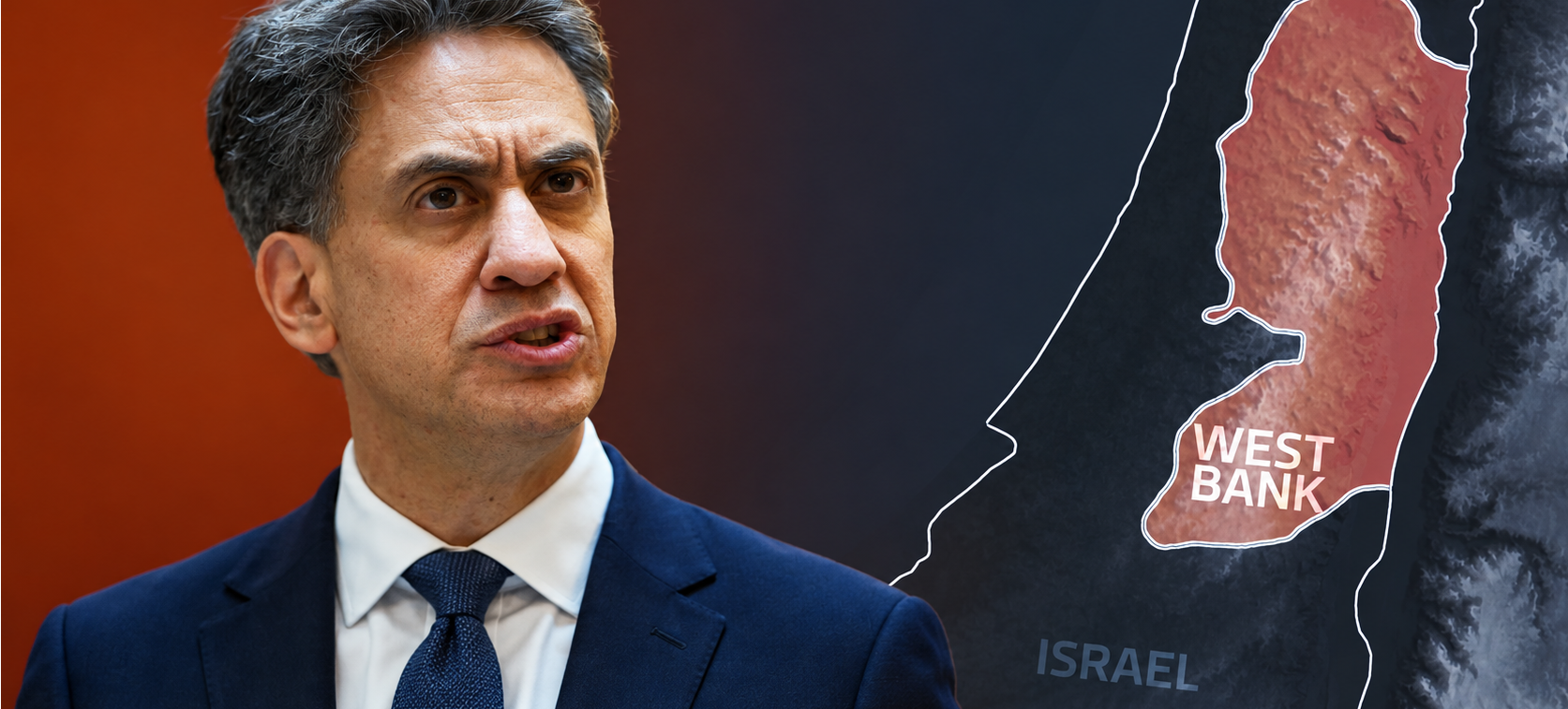
On Tuesday 8th September 2026, the United Kingdom, France and Canada announced plans for sanctions on illegal Israeli settlements in the occupied West Bank a coordinated move that underlined Israel’s growing isolation on the international stage. British Foreign Secretary Ed Miliband announced both comprehensive sanctions on Israeli settlements and a ban on all arms licences to Israel in Parliament, describing the measures as a “comprehensive reset” of UK policy on Israel.
Miliband stated in Parliament that “the official view of the British government is that the occupation is unlawful” — accepting the 2024 advisory opinion of the International Court of Justice and confirmed that “the British government agrees that there is ethnic cleansing of Palestinians in areas of the West Bank perpetrated by settler terrorists.”
Israel’s response was swift and severe. Israel announced it would close Britain’s consulate in occupied East Jerusalem. Israeli Foreign Minister Saar also said Britain would no longer be permitted to participate in the US-led coordination mission for Gaza, that British training of Palestinian Authority forces in the West Bank would be terminated, and that some elected UK officials would be banned from entering Israel.
Notably, Prime Minister Andy Burnham briefed President Donald Trump on his plans the day before the announcement, and Downing Street pressed ahead despite the risk of angering Washington — a signal that the move carried at least some political cost.
This was not nothing. But what it actually means requires understanding both what it covers — and, crucially, what it deliberately does not.
The Geometry of the Sanctions — What Is Targeted and What Is Not
This is where the announcement demands the most careful reading because the gap between the language used and the scope of the action is significant.
The ban covers imports of goods from Israeli settlements in the occupied West Bank, sanctions against extremist settlers who have supported or incited violence against Palestinians, and a refusal of all new export licences for weapons and other exports which “materially contribute to the occupation.”
However, the ban explicitly does not cover products and services from Israel itself. UK-Israel trade totalled £6 billion in 2025. That £6 billion continues to flow. The Israeli state — its government, its military, its economy is not sanctioned. Only the settlers in the West Bank are targeted.
This distinction is not technical. It is political. And it matters enormously.
The sanctions say, in effect: what the settlers are doing in the West Bank is ethnic cleansing and we will act against it. But what the Israeli government is doing in Gaza two years of bombardment, the destruction of an entire civilian infrastructure, the killing of tens of thousands does not yet meet the threshold of action of equivalent weight. Burnham has not spoken to Benjamin Netanyahu since taking office in July. His government has still refused to use the word genocide in relation to Gaza, insisting that determination belongs to international courts — even as it freely uses the phrase “ethnic cleansing” in relation to the West Bank.
The word genocide carries specific legal obligations under international law. Avoiding it is not caution. It is a choice — and it is a choice that limits what this government is politically committing itself to do.
Furthermore, some MPs have already requested the government go further and introduce a full legal ban on trade with Israeli settlements indicating that even within Parliament, this announcement is viewed by many as insufficient. The legislative framework will not be fully in place for six to nine months. In the interim, the measures are guidance rather than law.
To summarise the geometry plainly: the UK has sanctioned illegal settlers in the West Bank. It has not sanctioned the Israeli government. It has not addressed the genocide in Gaza with equivalent action. It has not banned trade with the Israeli state. And it has taken two years and a change of Prime Minister to get here.
How We Got Here — The Political Journey
To understand this week’s announcement, you have to go back to October 2023.
After October 7th when Israel launched its genocidal campaign in Gaza, then-opposition leader Keir Starmer gave an interview to LBC radio. Asked whether Israel had the right to cut off power and water to Gaza, he said yes. He later insisted his words had been misinterpreted. But for hundreds of thousands of British Muslims and for many others the damage was done.
A poll found that only 60 per cent of Muslim voters planned to support Labour at the next election, compared to 86 per cent who had backed Jeremy Corbyn in 2019. Labour paid a serious price in 2024, losing seats in Muslim areas to pro-Gaza independents. In 21 constituencies, Muslims make up more than 30 per cent of the population. The electoral mathematics were not subtle.
Starmer eventually resigned. Andy Burnham, before becoming Prime Minister, issued a public apology for Labour’s stance on Gaza, saying the party “didn’t get it right” and “needs to do better.”
And then within weeks of entering Downing Street the settlement ban that analysts had been predicting for months as his first gesture toward former Labour supporters arrived, exactly as forecast. A UK official went so far as to say that the behaviour of the next Israeli government could affect the scope of future West Bank sanctions a statement that reveals how transactional and conditional this policy framework remains.
The timeline is not a conspiracy. It is simply the visible mechanics of democratic politics. And it is essential context for any honest reading of what this week’s announcement means.
The Question of Sincerity
This is the question that sits at the heart of the article and it does not have a clean answer.
The Islamic tradition has always understood that the test of sincerity is not words. It is action taken at cost. We judge by what is apparent whilst acknowledging that Allah alone knows what lies beneath. By that standard, this announcement passes one test: it cost something real. Downing Street took an unusually bold step in angering Washington by pressing ahead with the sanctions announcement. A purely cynical gesture does not absorb that kind of diplomatic risk.
But it fails another test: it arrived two years late, after sustained electoral punishment, following a leadership change, and in a form that had been publicly predicted for months. Sincerity rarely arrives on such a predictable schedule.
The honest position is that both things can be true simultaneously. A government can take a right action for mixed reasons. A policy can be genuinely meaningful and politically motivated at the same time. What matters more than the motivation is what comes next. A single trade ban on settlements is a data point. A pattern of sustained action — on Gaza, on the Israeli government itself, on recognition of genocide, on accountability at the international level would be evidence of something more substantial. Without that pattern, this week remains a significant gesture in search of a larger commitment.
How to Absorb This as a British Muslim
The Quran repeatedly calls the believer to tafakkur to reflect carefully, to look beneath the surface of things. Political life is precisely the domain where that careful thinking is most needed and most easily abandoned.
Welcome the policy without conferring trust. These are two different things. A ban on settlement imports is welcome. But trust is rebuilt through sustained action, not through a single announcement that arrives when it is politically convenient.
Name the gap between language and action. A government that describes “ethnic cleansing” in the West Bank whilst declining to name what happened in Gaza where tens of thousands (unofficial estimates in the hundreds of thousands) were killed over two years is making a very careful set of linguistic choices. Those choices are not neutral. They reflect what this government is and is not prepared to commit to.
Understand what is not being targeted. The Israeli government itself its leadership, its military, its broader economy remains outside the scope of these sanctions. £6 billion in annual trade continues. Netanyahu has not been called. The relationship with the Israeli state, as distinct from the settlers, has been reset in language but not yet in substance.
And hold the larger picture. The Palestinian cause is not served by any single government’s policy announcement. It is served by sustained, principled, international pressure legal, economic, diplomatic and moral that does not ebb and flow with electoral cycles.
An Open Question
The measure of any government’s sincerity is not what it does on the day it needs to be seen to act. It is what it does on the days when doing the right thing costs more than it is comfortable paying.
That day has not yet fully arrived for the Burnham government. What happened this week was a step. Whether it is the first step of a genuine journey, or a resting point that substitutes for one British Muslims, and all people of conscience now have enough context to watch, to judge, and in time, to know.
“O you who believe, if a wicked person comes to you with any news, ascertain the truth.”
— Surah Al-Hujurat, 49:6