


Every civilisation eventually reveals what it worships.
Some worship empire.
Others wealth.
Others race, nationalism, technology, or military power.
The modern world, despite its language of human rights and international order, increasingly measures legitimacy through dominance. Nations are respected not for moral clarity but for economic leverage, military reach, and strategic usefulness. The strong define reality; the weak endure it.
In such a world, suffering often becomes statistical.
Entire populations are reduced to geopolitical calculations. Children disappear beneath rubble while global powers debate “stability”. Economic systems reward excess while millions struggle beneath inflation, debt, and displacement. Public discourse increasingly celebrates arrogance as strength, cruelty as realism, and moral compromise as political maturity.
Against this backdrop, Hajj emerges as something far more profound than a religious obligation: Islam’s annual rebellion against arrogance, hierarchy, and the worship of power.
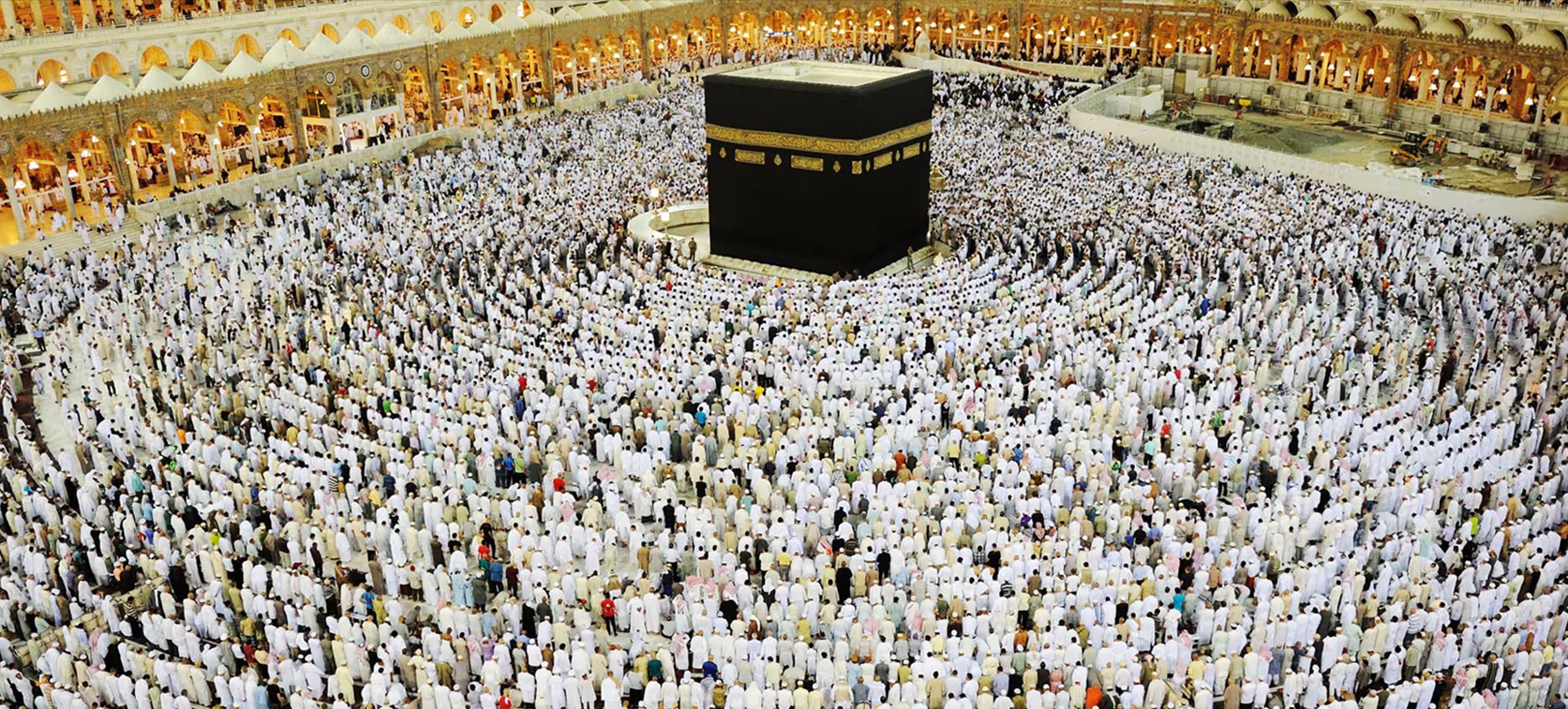
For over fourteen centuries, millions of Muslims have travelled to Makkah carrying different languages, cultures, incomes, and histories. Yet upon entering the state of ihram, the symbols through which society ranks human worth are deliberately stripped away.
No tailored suits.
No military uniforms.
No royal garments.
No designer labels.
No outward distinction between executive and labourer, politician and refugee.
Two simple white cloths reduce humanity to its most honest condition: fragile, temporary, and equal before God.
It is difficult to think of another gathering on earth where status is so intentionally dismantled.
Modern political culture is built upon performance. Power must constantly display itself. Nations parade military hardware through capitals. Leaders cultivate images of strength. Wealth is transformed into spectacle through branding, exclusivity, and excess. Even ordinary people are encouraged to market themselves endlessly in pursuit of validation.
Hajj moves in the opposite direction.
The pilgrimage does not elevate the self; it disciplines it.
It does not celebrate ego; it dissolves it.
Nowhere is this more striking than in tawaf, the circling of the Ka‘bah. Millions move around a single centre, declaring through action that nothing occupies the true centre of existence except Allah.
Not empire.
Not markets.
Not governments.
Not the self.
The political implications of this are immense.
A civilisation rooted entirely in material power inevitably drifts toward excess. The Qur’an repeatedly returns to the stories of peoples destroyed not simply because they possessed power, but because power produced arrogance.
Fir‘awn is condemned not merely as a ruler, but as a man intoxicated by superiority. His declaration — أَنَا رَبُّكُمُ الْأَعْلَىٰ (“I am your highest lord”) — represents the corruption that emerges when authority frees itself from morality.
That temptation remains deeply contemporary.
Modern states may not openly declare themselves divine, yet many behave as though accountability belongs only to the weak. International law is applied selectively. Violence becomes acceptable when committed by allies. Economic exploitation is repackaged as necessity. Entire populations are expected to absorb humiliation quietly in the interests of “global order”.
Hajj interrupts this logic.
Nowhere more powerfully than on the plains of Arafah, where pilgrims stand exposed beneath the desert sky awaiting divine mercy. There, every illusion of permanence collapses. Titles disappear. Wealth becomes irrelevant. Influence carries no currency. Human beings stand as they ultimately will on the Day of Judgement: without entourage, image, or worldly protection.
It is perhaps one of the few remaining mass gatherings in the modern world that actively trains human beings in humility rather than self-assertion.
Even the symbolic stoning of the Jamaraat takes on renewed meaning in this context. Traditionally understood as a rejection of temptation, it also represents a rejection of the oldest political disease in history: arrogance — the belief that power excuses injustice and superiority grants entitlement.
The Qur’an offers a remarkably concise principle against this corruption:
تِلْكَ الدَّارُ الْآخِرَةُ نَجْعَلُهَا لِلَّذِينَ لَا يُرِيدُونَ عُلُوًّا فِي الْأَرْضِ وَلَا فَسَادًا
“That Home of the Hereafter We assign to those who do not seek superiority upon the earth nor corruption.” (القصص 28:83)
This verse captures the moral essence of Hajj itself. The pilgrimage is not an escape from the world’s crises. It is a corrective to the spiritual diseases that produce them.
And perhaps this is the deeper lesson Hajj leaves behind after the pilgrims return home.
The rebellion against arrogance was never meant to remain confined to the plains of Arafah or the days of Dhul Hijjah. Hajj reminds Muslims that they possess an entirely different vision for society.
A civilisation cannot endlessly preach human rights whilst profiting from war.
It cannot speak of freedom whilst entire populations live beneath occupation, sanctions, surveillance, and economic servitude.
Nor can it claim moral leadership while power alone determines whose suffering matters and whose deaths are politically inconvenient.
The present global order increasingly resembles a system in moral decline: technologically advanced, yet spiritually hollow; materially powerful, yet ethically fragile. It rewards domination over justice, image over truth, and profit over human dignity. A small political and economic elite shapes the lives of billions whilst ordinary people carry the burden of war, inflation, displacement, and social decay.
Islam does not ask Muslims merely to spiritually survive such a world. It asks them to challenge its assumptions.
Hajj demonstrates, in living form, that humanity does not need to organise itself around arrogance, exploitation, and the worship of power. For a brief moment each year, millions gather upon principles the modern world increasingly struggles to uphold: humility, equality, accountability, restraint, and submission to a higher moral authority than the state, the market, or the ego.
In this sense, Hajj is not only a pilgrimage.
It is a glimpse of an alternative civilisation.
A reminder that Fir‘awn is not simply a figure from ancient history, but a recurring political condition — one that emerges whenever power frees itself from morality.
And like every arrogant order before it, this one too will eventually pass.
Empires collapse.
Elites fade.
The powerful become footnotes in history.
But truth remains.
Perhaps the real question Hajj leaves Muslims with is whether they — both in the sacred plains of Hajj and in their lives back home — possess the courage to work towards a civilisation worthy of Islam’s vision; a civilisation that one day will look back upon this age of arrogance, endless war, exploitation, and elite domination as one of the darkest and most backward eras in human history.
Need Help?
-
 [email protected]
-
 Follow us on Instagram
-
 Follow us on TikTok