


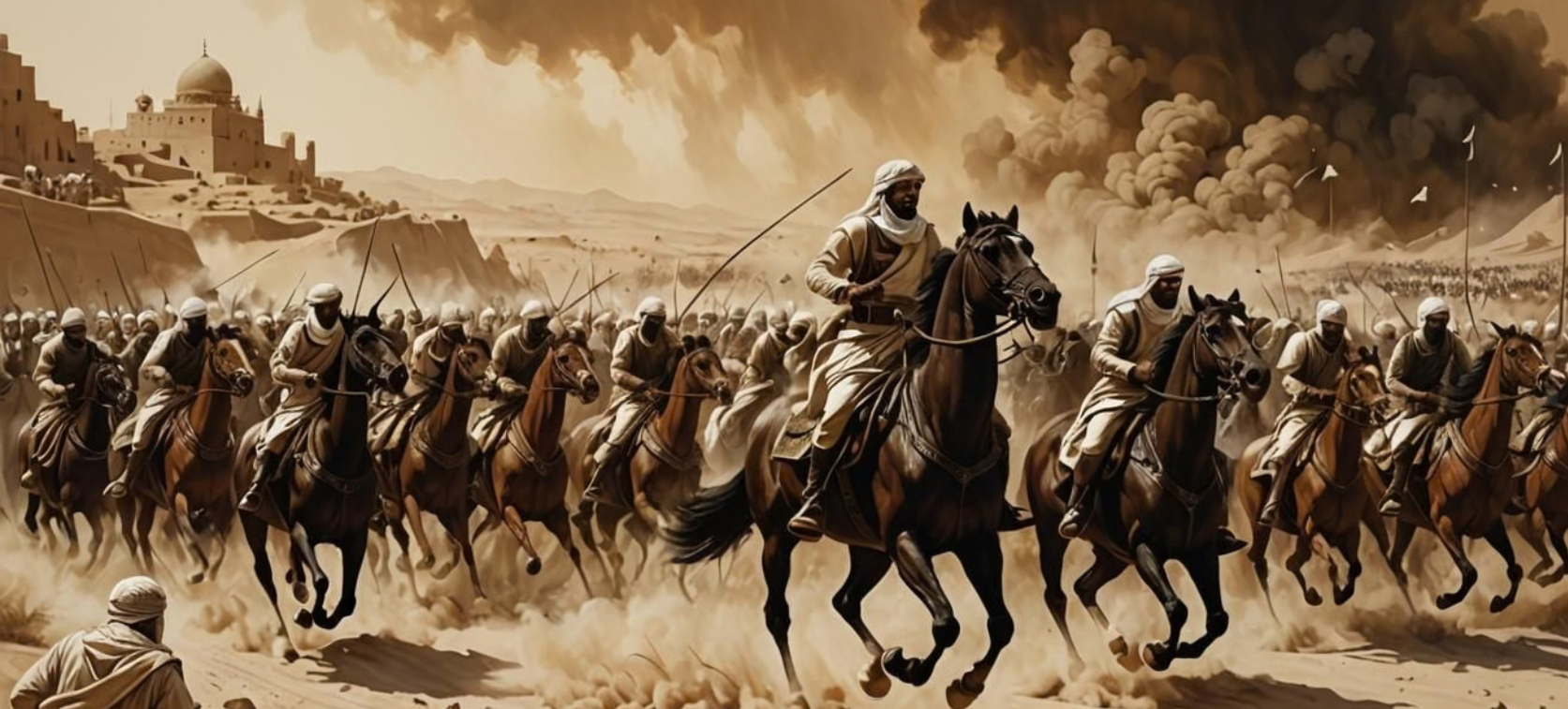
The 17th of Ramaḍān is a date that carries deep historical significance for the Muslim Ummah. It was on this day that the young Muslim community faced the Quraysh at the Battle of Badr, marking the first clear articulation of Islamic foreign policy.
Ramadan did not arrive in history as a purely devotional season. It descended into a world of tribes, empires, trade routes and power struggles. The Qur’an was revealed to a community that prayed, fasted, negotiated, defended itself and eventually governed.
Yet in contemporary Muslim discourse, Ramadan is often framed almost entirely as a private spiritual exercise — a month of fasting, charity and personal renewal. All of that is true. But it is not the full picture. Ramadan was also the month in which the young Muslim community asserted its place in the world.
Badr: The First Assertion of Sovereignty
In the second year after the migration to Madinah, Muslims faced the army of Quraysh at Badr. The Battle of Badr is remembered by many as a miracle — angels descending, a small force overcoming a larger army, divine support for the believers.
But Badr was more than a miracle. It was a moment of political definition. The Muslim community in Madinah was no longer simply a persecuted minority that had emigrated from Makkah. It had become a political entity capable of defending its interests, protecting its trade routes and asserting sovereignty.
In other words, Badr was not simply a battle. It was the first clear articulation of Islamic foreign policy. The Prophet ﷺ did not lead a spiritual sect detached from the world. He led a polity. Treaties were negotiated. Envoys were sent. Trade routes were secured. Alliances were formed and broken. Faith and statecraft existed within the same moral framework. Ramadan sharpened the discipline required for both.
When Foreign Policy Disappeared from Muslim Consciousness
For centuries, Islamic civilisation produced empires, legal traditions, diplomatic practices and military doctrines that governed relations between states. But the collapse of the Ottoman Caliphate in 1924 marked a profound shift.
With the disappearance of a widely recognised central political authority, Islam increasingly came to be understood — both internally and externally — as primarily a personal faith rather than a governing civilisational framework. The consequences of this transformation are subtle but profound.
Islam today is commonly framed as a moral code for individuals, a spiritual identity for communities, and a cultural tradition within nation-states. What largely disappears from discussion is Islam as a political force among nations. Foreign policy — once a normal function of Islamic governance — becomes either a historical curiosity or an uncomfortable topic. The concept of jihad, stripped from its legal and political framework, becomes either taboo or dangerously misunderstood.
Over time, a generation emerges that can explain how to fast in Ramadan but struggles to explain how an Islamic civilisation would interact with the world politically.
From Badr to Bretton Woods
To understand the consequences of this intellectual shift, we must examine the global order within which Muslim-majority states operate today. The modern international system was shaped in the aftermath of the Bretton Woods Conference in 1944. From it emerged institutions such as the International Monetary Fund, the World Bank and the United Nations — bodies that would structure global finance, diplomacy and security in the post-Second World War era.
Muslim-majority states entered this system not as architects but as participants. Their currencies became tied to global financial networks. Their security arrangements became intertwined with external powers. Their military procurement and defence strategies became embedded in alliances shaped outside the Muslim world.
Foreign policy therefore increasingly follows the logic of the international system rather than a shared civilisational vision. The reference point becomes Bretton Woods. Not Badr.
The Iran Crisis and the Cost of Fragmentation
From a strategic perspective, such escalation carries enormous risks: energy markets are destabilised, shipping through the Strait of Hormuz — through which a large share of the world’s oil passes — faces disruption, and retaliatory strikes have spread across the Gulf region.
Yet despite these risks, external powers continue to act with relative strategic confidence. Why? Because there is no unified Muslim geopolitical bloc capable of imposing meaningful collective consequences.
Instead, the opposite often occurs. Regional states respond through fragmented alliances, security dependencies and rivalries. Some host military infrastructure belonging to external powers. Others align diplomatically with competing blocs.
In such an environment, geopolitical miscalculations by major powers can be absorbed by regional fragmentation. The absence of a unified strategic response cushions the consequences. The blushes of global powers are saved not by flawless strategy — but by the absence of coordinated opposition.
When Civilisations Stop Thinking About Power
The deeper problem is not merely political fragmentation. It is intellectual silence. Within many religious institutions today, discussions of sovereignty, geopolitics and foreign policy are often avoided altogether. Political thought is treated as dangerous territory rather than an essential component of civilisational life.
The unintended consequence is the emergence of a generation that sees Islam as governing prayer and charity — but not power. Badr becomes a moral story rather than a lesson in strategic agency. Jihad becomes either an embarrassing word or a misunderstood slogan. And the possibility of coordinated Muslim political thought begins to feel unrealistic, even irrational. A civilisation that once negotiated with emperors and reshaped global trade routes now hesitates to imagine its own role in world politics.
Ramadan as Civilisational Memory
Ramadan was never meant to produce only private piety. It cultivated discipline, sacrifice and clarity of purpose within a community that understood its responsibility in the world. Fasting trained individuals to restrain desire. But it also trained a society to subordinate immediate comfort to long-term vision.
The generation that fought at Badr had fasted, prayed and reflected — but it had also thought seriously about power, responsibility and justice. Ramadan was not an escape from the world. It was preparation to engage it.
A Reminder for Those Who Speak in Ramadan
There is also a reminder here for those who speak during this month. For those who stand on the mimbar of the Messenger of Allah ﷺ during Tarawih nights, during Jumu’ah sermons and during the khutbahs of Eid. And for those who claim the responsibility of carrying da‘wah in the modern world.
Too often today the excuse is repeated: “We do not know enough about what is happening.” “This is too political.” “It is better not to comment.” At other times the discussion is reduced to tweets, short clips and commentary designed to avoid controversy. But history teaches that silence does not protect a civilisation. It simply accelerates its decline.
To detach the concept of jihad from Islamic discourse out of fear of being labelled radical or extreme is not intellectual caution. It is historical amnesia. Jihad in the Islamic tradition was never a call for scattered individuals to take up arms in chaos. It existed within a comprehensive political framework — a system of governance, law, diplomacy and accountability. It belonged to a civilisation that understood sovereignty.
The generation of Badr did not produce slogans. It produced a political order. And that is the conversation many prefer to avoid today.
The real question is not whether individuals should act in isolation. The real question is whether Muslims can once again think seriously about the political framework that produces an ethical foreign policy — the kind of foreign policy that emerged from Badr. When that conversation disappears, Islam is quietly reduced to personal spirituality while the structures of power that shape the world are left entirely to others.
Those who carry the message of Islam must decide which role they are playing. Because there is a difference between a da‘wah carrier and a content creator. There is a difference between an imam and an orator. One speaks to please an audience. The other speaks to awaken a civilisation.
Ramadan once produced a generation that reshaped the balance of power in Arabia. If those who stand on the mimbar cannot even speak honestly about the civilisational responsibilities of Islam, then perhaps the mimbar has been reduced to a stage and the sermon to performance. And if that is the case, it would be better to remain silent at home than to inherit the legacy of the Prophet ﷺ while being afraid of the very ideas that once gave the ummah its confidence in the world.
Need Help?
-
 [email protected]
-
 Follow us on Instagram
-
 Follow us on TikTok